
Crypto regulation in Germany
Crypto is legal in Germany and sits inside the same financial law as shares and bonds: firms need a BaFin license, transfers carry sender and recipient data, and private investors pay no income tax on coins held longer than one year. Crypto service providers also report their customers' transactions to the tax office. Dated events are in the calendar below.
How crypto fits into German financial law
German law treated crypto as part of the regulated financial market before the EU had its own rulebook. The Banking Act (KWG) counted crypto assets as financial instruments, and crypto custody needed a BaFin license years before MiCA. Today the EU's Markets in Crypto-Assets Regulation (MiCA) sets the license and conduct rules for crypto service providers across the EU, and the German Kryptomärkteaufsichtsgesetz (KMAG) names BaFin as the supervisor. The licensing path, the German transition period and the passport into other EU states are on the page on MiCA in Germany.
MiCA is only one of several layers. Tokenized bonds and shares stay under securities law: the Electronic Securities Act (eWpG) allows crypto securities that live in a register on a distributed ledger, and keeping that register is a financial service that needs a BaFin license. Anti-money laundering rules apply through the German Money Laundering Act (GwG) and EU law, and the tax rules come from the Income Tax Act and the tax authorities. A crypto firm in Germany therefore works with four sets of rules at once: license, securities, money laundering and tax.
Is crypto legal in Germany?
Yes. Buying, holding, trading and selling bitcoin and other crypto assets is legal for private persons and companies in Germany. What is regulated is the business around it. A company that holds crypto for customers, runs a trading platform, exchanges crypto for euros or gives advice needs authorization as a crypto-asset service provider, either from BaFin or from another EU supervisor with a passport into Germany. Banks and securities firms with an existing license can add crypto services after notifying BaFin.
A private investor can check whether a provider holds a German license in BaFin's company database. Firms that offer crypto services in Germany without a license commit an offense, and BaFin publishes warnings about them. The largest crypto exchanges in Germany page lists which platforms hold which license.
Crypto tax in Germany: the one-year rule
For private investors, crypto is taxed as a private disposal under section 23 of the Income Tax Act. The Federal Ministry of Finance set out the details in its letter on crypto assets (in German). A gain on coins sold or swapped within one year of purchase is taxable at the personal income tax rate. After more than one year the gain is tax-free. Short-term gains stay tax-free up to an exemption limit of 1,000 euros a year; above it, the whole gain is taxable, not only the part over the limit. A swap from one coin to another counts as a sale.
Staking and lending rewards are income when they are received. The ministry's letter adds a rule for rewards that sit unclaimed: they count as received no later than the end of the year. Companies are taxed differently, because the one-year rule applies only to private assets. Classic investment products work another way again: a crypto ETP bought through a bank is taxed like other securities, a difference explained on the crypto ETP page.
DAC8: crypto firms report to the tax office
The EU's eighth directive on administrative cooperation in tax matters, DAC8, brings automatic reporting to crypto. Germany implemented it with the Kryptowerte-Steuertransparenzgesetz (KStTG). Crypto service providers with a seat or business in Germany collect their customers' names, addresses and tax identification numbers and report the year's transactions to the Federal Central Tax Office (BZSt), with the first reports due by July 31 of the year after the reporting year. According to KPMG (in German), the framework builds on the OECD's Crypto-Asset Reporting Framework, so the tax office sees crypto trades the way it has long seen bank interest and dividends.
The travel rule and money laundering
Every crypto transfer between service providers in the EU carries the name and account data of sender and recipient, with no minimum amount. This is the travel rule of the EU Transfer of Funds Regulation, which replaced a national German rule, the Kryptowertetransferverordnung. Transfers to and from self-hosted wallets need extra checks above 1,000 euros. The page on the travel rule for crypto explains the data flow.
Money laundering supervision is also moving. The new EU Anti-Money Laundering Authority (AMLA) has its seat in Frankfurt and will directly supervise some of the largest cross-border financial firms, which can include crypto-asset service providers. Compliance teams at German crypto firms therefore follow three authorities: BaFin for the license, the BZSt for tax reporting and, over time, AMLA. Anti-money laundering in crypto and crypto compliance training cover the daily work.
Upcoming crypto events in Germany
Crypto regulation at Finance Loop
Finance Loop is the meeting place for compliance officers, lawyers and tax advisers at banks, crypto firms and asset managers. It connects the finance, IT and AI communities in Frankfurt and holds events in Munich, Berlin and Hamburg as well.
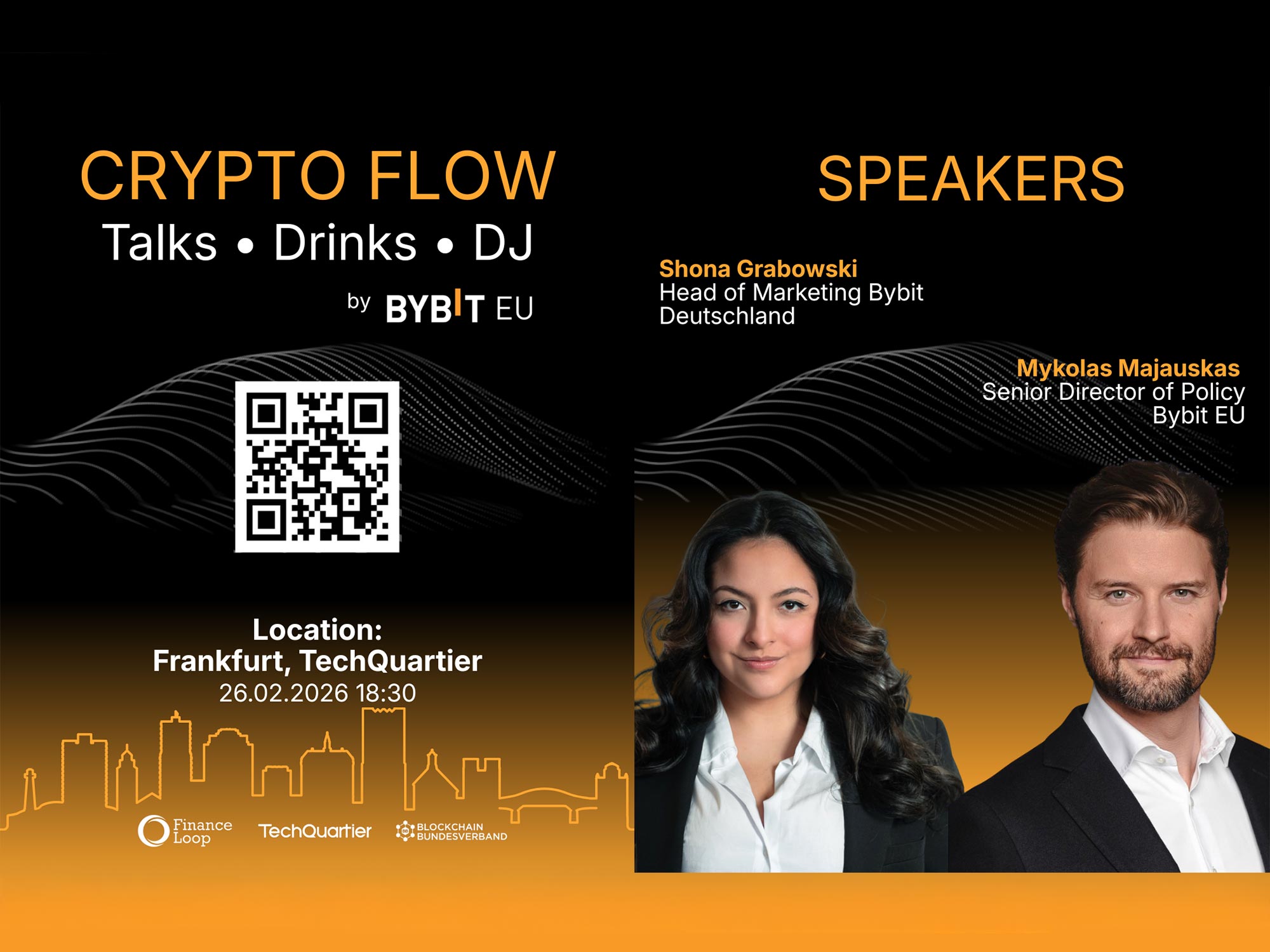
Finance Loop partnered with CAC 2026, the Crypto Assets Conference hosted by Frankfurt School and Deutsche Börse, whose program covered regulatory frameworks, and with the Forum für Digitale Vermögenswerte, where MiCAR and compliance were topics. At the Bybit EU Crypto Evening at TechQuartier a senior policy director spoke on compliance under MiCAR. The MiCAR executive program of EBS Executive School and the law firm HEUKING teaches the rules in German at the EBS campus in Oestrich-Winkel. Finance Loop is a founding member of the Bitcoin Bundesverband, and its Bitcoin for Investors masterclass explains bitcoin to professional investors, including the rules that apply.
Investment & Digital Assets
Payments & Digital Money
Risk & Compliance
Is crypto legal in Germany?
Yes. Private persons and companies may buy, hold and sell crypto. Firms that provide crypto services to customers need a license under MiCA, granted in Germany by BaFin, or a license from another EU state that is passported into Germany.
How is crypto taxed in Germany after one year?
For private investors, a gain on crypto held for more than one year is tax-free. Within one year it is taxable at the personal rate, with an exemption limit of 1,000 euros a year for all short-term private disposals. The Finance Ministry's letter (in German) sets out the details.
How do I check whether a crypto exchange has a BaFin license?
Search the provider's name in BaFin's company database. A provider licensed in another EU state appears there if it has passported its services into Germany; ESMA also keeps an EU-wide register of crypto-asset service providers.
Is there a crypto regulation event in Frankfurt?
Finance Loop runs and supports crypto events in Frankfurt where regulation is a regular topic, from evenings at TechQuartier to conferences such as CAC and the Forum für Digitale Vermögenswerte. Dates are in the calendar on this page.
Crypto regulation in Germany and Finance Loop
Crypto regulation touches two Finance Loop tracks, Investment & Digital Assets and Risk & Compliance. Finance Loop partnered with CAC 2026 and the Forum für Digitale Vermögenswerte, both with regulation on the program, and is a founding member of the Bitcoin Bundesverband. People who work on these rules meet at Finance Loop events across Germany, Austria and Switzerland.
Finance Loop is a professional network and has the goal of driving the adoption of emerging technologies in finance, such as AI, tokenization, stablecoins, and DeFi. Finance Loop helps its members build skills and personal networks in these fields: Investment & Digital Assets, Payments & Digital Money, and Risk & Compliance.