
Gaia-X and finance: rules for data, not a cloud
A bank comparing two cloud offers reads two marketing pages that use the same words for different things. Gaia-X exists to fix that: it defines how a provider describes its own service in a form a machine can read and a buyer can compare. For finance that matters less for buying infrastructure and more for building data spaces, where several institutions exchange data under rules all of them can verify.
Gaia-X is an association in Brussels, the Gaia-X European Association for Data and Cloud AISBL, with European companies, technology vendors, cloud providers, standards bodies and public institutions as members. It publishes specifications. It operates no cloud.
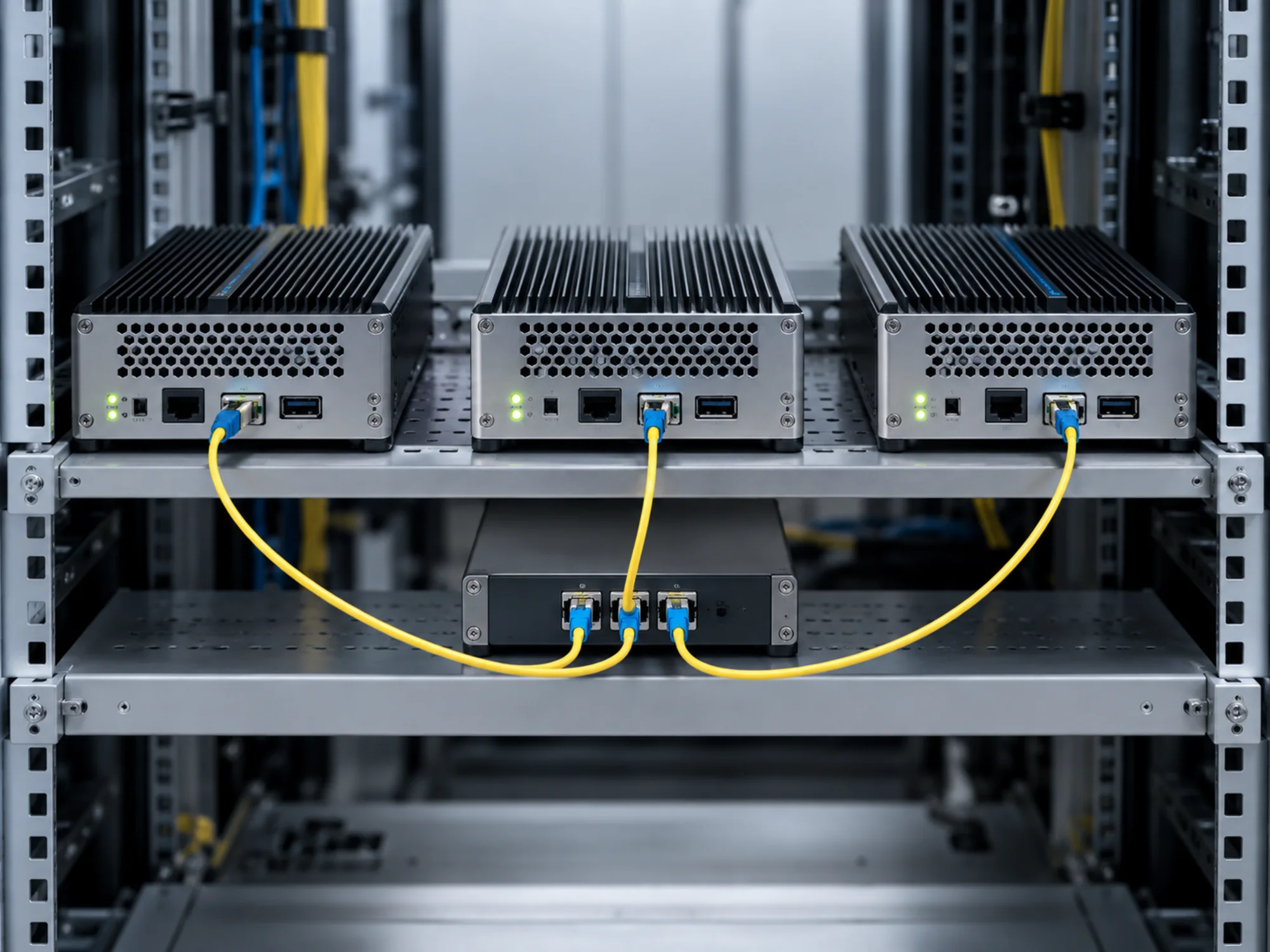
What Gaia-X produces: the Trust Framework
The Gaia-X output is a framework, not a platform. A provider writes a self-description: a machine-readable document stating who operates the service, in which jurisdiction the operating entity sits, where the data is stored and processed, which certifications apply and which sub-processors are involved. Compliance rules then say what a valid self-description has to contain, and a clearing house checks a submitted description against those rules.
The value for a buyer is comparability. Two providers' claims about residency, jurisdiction and certification arrive in the same structure, so a procurement team compares fields instead of prose. The page on sovereign cloud for banks covers what those same three questions mean inside a contract, which is the other half of the assessment.
The Gaia-X Hub Germany and the German association
Gaia-X runs national hubs that gather the requirements of a country's industries and feed them into the specification work. The German hub is organized through Gaia-X Hub Germany, which coordinates domain groups across sectors including finance and insurance, and it is where a German bank's requirements enter the process. A separate German association, Gaia-X Deutschland, carries the national organization behind that work.
What a hub does is collect use cases and turn them into requirements for the framework. It does not procure anything and it does not certify a provider.
Finance data spaces and what they exchange
A data space is a set of participants who exchange data under common rules on identity, access and usage, with no central operator holding the data. Gaia-X supplies the trust layer for that: each participant's identity and each service's description are verifiable, so a participant knows who is on the other side of a request and under which terms. Gaia-X describes data spaces across sectors including finance and banking, alongside health, energy and mobility.
The finance cases follow the data that several institutions need and none owns alone. Sustainability reporting pulls figures from portfolio companies through several intermediaries. Credit assessment needs verified company data from registers and from the company itself. Fraud and payments work needs signals that no single bank sees in full. In each case the hard part is agreeing who may use which field for which purpose, which is what a data space writes down and the cloud computing in financial services page frames from the infrastructure side.
Why the association is not a cloud provider
Press coverage repeatedly treats Gaia-X as a European cloud meant to compete with the hyperscalers, and German autocomplete carries the follow-up questions that come from that framing. The confusion has a source: the project was announced in 2020 as an answer to European dependence on a handful of non-European providers, and the announcement was read as a plan to build infrastructure.
What was actually built is a specification body with a compliance process. A bank that wants capacity buys it from a provider, European or not, and uses Gaia-X artifacts to check what that provider claims. Reading the association as a provider leads a procurement team to look for a product that was never on offer.
The link to the EU Data Act's switching provisions
The EU Data Act obliges cloud and edge providers to let a customer switch to another provider or to on-premises systems, with contractual notice periods, transition assistance and the removal of switching charges after a phase-in. The obligation says a customer must be able to move. It does not say the target provider will accept the data in the shape it arrives.
That is where the two instruments meet. A Data Act right to switch is only usable where the services are described comparably enough to identify an equivalent, and where the data and metadata formats are known in advance. A Gaia-X self-description is one way to hold that information before the switch is needed, which is the same discipline the exit clause on the sovereign cloud page demands, and the same dependency logic the digital operational resilience in Europe page applies under DORA.
Can a bank buy cloud from Gaia-X?
No. Gaia-X sells no capacity and operates no data center. A bank buys cloud from a provider and can ask that provider for a Gaia-X self-description of the service, which is a document about the service and not the service itself. Where the bank wants European providers with verified sovereignty properties, the European Commission's own procurement criteria are the nearer reference, and the sovereign cloud page covers them.
What does Gaia-X give a finance data space that a contract does not?
Machine-checkable identity and service descriptions for participants a bank has no bilateral contract with. A contract works for two parties who negotiated it. A data space with twenty participants cannot run on twenty bilateral agreements renegotiated whenever a participant joins, so the rules have to be stated once and verified automatically for each party. That is the problem a trust framework addresses.
The sovereignty levels, and what Level 3 demands
The framework grades sovereignty instead of asserting it, with tiered levels, and the top tier is where the demand actually sits for sensitive workloads. Level 3 is reserved for the highest-sensitivity cases and requires the provider to be headquartered in Europe, so that extraterritorial law such as the US CLOUD Act does not reach it. The demand for that tier has come from aerospace, energy and national infrastructure, with EDF's nuclear station program named as an example.
For a bank the levels are useful as a sorting tool for its own estate. Most banking workloads do not need a Level 3 provider, and a bank that demands it everywhere narrows its supplier list for no supervisory gain. The ones that plausibly do are the systems whose compromise would be a matter for the state and not only for the institution.
How far the implementation has actually got
A bank planning on Gaia-X should know the state of deployment, because the specification is further along than the practice. Over 150 implementation projects are in preparation, while only a handful of operational data spaces are delivering the benefit in production. The first multi-provider catalogue launched with roughly 600 services from 15 providers, with targets of 1,000 and then 3,000 services.
The honest reading is that the trust framework is usable today as a way to ask a provider for structured claims, and that a data space a bank wants to join may still be a project and not a service. The question to ask a data space initiative is which participants are in production, and what happens to the data if the initiative stops.
Who pays for a data space to keep running?
This is the question that decides whether a finance data space survives its pilot, and it is the one most initiatives answer last. A data space has running costs for the trust infrastructure, the governance body, the onboarding of new participants and the maintenance of compliance as rules change, and no single participant owns the thing that would justify paying for all of it.
The models in use are membership fees, transaction-based charges, a consortium funding a shared operator, or a public body carrying the base cost. The point for a bank evaluating an invitation is to ask for the model before integrating, because an initiative with no cost-recovery mechanism will stop, and the integration work is sunk when it does.
Data sovereignty and Finance Loop
Finance Loop covers data spaces and sovereignty specifications in its Digital Infrastructure & Sovereignty track, where the architects who design these exchanges meet the compliance people who have to sign them off. Finance Loop holds its sessions in Frankfurt, which is where the German banks, the supervisors and the hosting capacity sit together.
Finance Loop is a professional network and has the goal of driving the adoption of emerging technologies in finance, such as AI, tokenization, stablecoins, and DeFi. Finance Loop helps its members build skills and personal networks in these fields: Investment & Digital Assets, Payments & Digital Money, Digital Infrastructure & Sovereignty, and Risk & Compliance.