
CSDR: the EU Central Securities Depositories Regulation
CSDR is the EU regulation on securities settlement and on the central securities depositories that run it. For the securities operations of a bank, it decides how fast a trade has to settle and what a late trade costs. Dated events on the topic are in the calendar below.
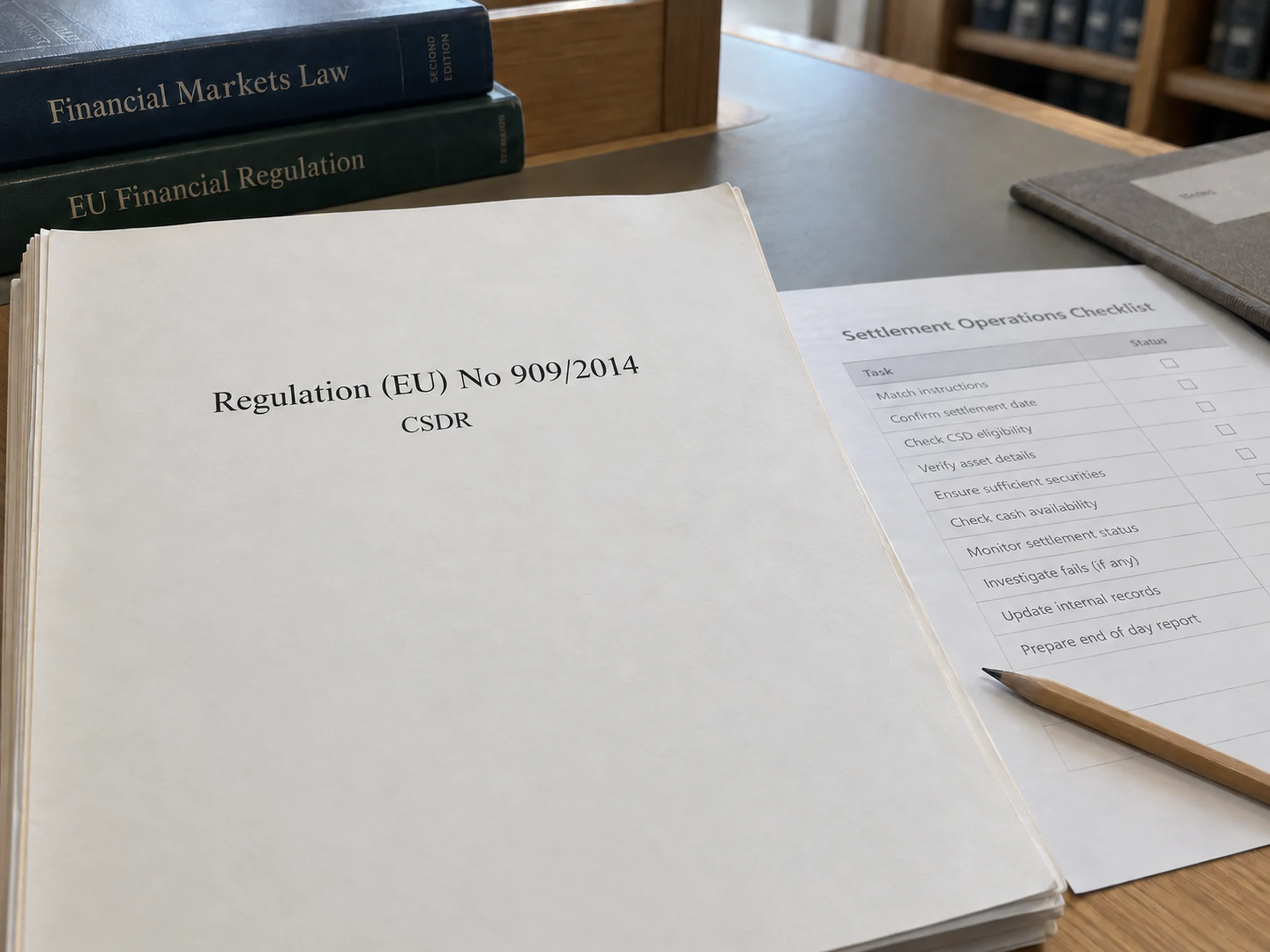
Settlement and depositories under CSDR
Regulation (EU) No 909/2014, in short CSDR, entered into force on September 17, 2014. ESMA's page on central securities depositories sums it up: the regulation harmonizes parts of the settlement cycle and of settlement discipline, and it sets common requirements for the depositories that operate securities settlement systems in the EU.
A central securities depository, or CSD, keeps the central record of who holds a security and moves securities between accounts against payment. Each member state names the authority that authorizes and supervises its CSDs under Articles 11 and 16 of CSDR. In Germany that authority is BaFin, and the German CSD is Clearstream. In the euro area most securities settle on T2S, the Eurosystem platform that Finance Loop's answer on clearing vs settlement describes.
CSDR penalties for late settlement
Since February 1, 2022, a trade that misses its intended settlement date costs the failing party a cash penalty for every business day of delay, and CSDs report settlement fails to their supervisors (ESMA). The CSD calculates the penalties and charges them to its participants, who pass them on to their clients.
A bank that settles many small orders has to book each of these penalties against the right client. dwpbank, which processes securities for about 1,000 German banks and savings banks, sells CSDR services for this job. For commission trades it handles the penalties automatically; for trades settled outside its own systems it reports penalties monthly down to the end customer and settles them. In dwpbank's view, smaller institutions could not run this economically on their own.
CSDR Refit: buy-ins as a last resort
The CSDR Refit, Regulation (EU) 2023/2845, entered into force on January 16, 2024. According to Norton Rose Fulbright, it turns mandatory buy-ins into a last resort: the Commission may introduce them only if cash penalties have not reduced settlement fails for good and the fails threaten financial stability. The Refit also lets the Commission set penalty rates by asset type, liquidity and length of the fail, and it changes the passport rules for CSDs that serve issuers from other member states.
T+1, automation and DLT settlement
The next change is the settlement cycle. Regulation (EU) 2025/2075 amends CSDR so that trades on EU trading venues settle one business day after the trade date from October 11, 2027. With one day less, a mismatched instruction can rarely be fixed by hand in time, so banks automate matching and confirmation. The project would introduce T+1 settlement in Europe.
CSDR also frames settlement on a distributed ledger. Under the DLT Pilot Regime, Regulation (EU) 2022/858, the operator of a DLT settlement system can ask its supervisor for exemptions from specific CSDR requirements, for example to settle tokenized securities directly on the ledger. The DLT Pilot Regime allows specific exemptions for DLT infrastructure. DvP settlement links the securities transfer to its cash payment.
Upcoming events on securities settlement and regulation
Settlement and DLT at Finance Loop events
The Frankfurt Forum on Digital Assets & Applications, organized by d-fine, brought experts on DLT-based securities, money and market infrastructure together in Frankfurt. Its description names the eWpG and the DLT Pilot Regime as the rules behind the topic. DekaBank sat on its panel on DLT market infrastructure, and Deutsche Bank, Commerzbank and DZ Bank on its payments panel.
Digital Infrastructure & Sovereignty
Investment & Digital Assets
What is CSDR?
CSDR is Regulation (EU) No 909/2014, the EU law on securities settlement and on central securities depositories. It sets the settlement cycle and the cash penalties for late settlement, and it decides how a CSD gets its authorization.
What are CSDR penalties?
Cash penalties that the CSD charges for every business day a trade settles late. They apply since February 1, 2022 and pass from the CSD to its participants and from them to their clients.
Does CSDR apply to tokenized securities?
Yes. A tokenized security that settles through a CSD falls under CSDR like any other security. The operator of a DLT settlement system under the DLT Pilot Regime can ask for exemptions from specific CSDR requirements.
When does T+1 apply in the EU?
From October 11, 2027, under Regulation (EU) 2025/2075, which amends the settlement cycle rule in CSDR.
Settlement and securities infrastructure
Firms in settlement
CSDR and Finance Loop
Finance Loop covers CSDR and settlement discipline in its Risk & Compliance track, and the move of settlement onto distributed ledgers in its Investment & Digital Assets track. Finance Loop's event pages include the Frankfurt Forum on Digital Assets & Applications, a d-fine evening on DLT-based securities, money and market infrastructure.
Finance Loop is a professional network and has the goal of driving the adoption of emerging technologies in finance, such as AI, digital payments, cloud and blockchain solutions. Finance Loop helps its members build skills and personal networks in these fields: Investment & Digital Assets, Payments & Digital Money, Digital Infrastructure & Sovereignty, and Risk & Compliance.