
Doing Business in Germany as a Fintech
For a fintech or software vendor, doing business in Germany mostly means selling to banks, insurers and asset managers. The banking market has three groups with different buying paths, every contract for a critical service has to pass a DORA and MaRisk review, and many decisions need two signatures by rule. Current bank projects include instant payments, crypto trading in the Sparkasse and Volksbank apps, and AI in credit and compliance. Dated events are in the calendar below.
How German banks buy
The Sparkassen share the core banking system OSPlus from Finanz Informatik, and the Volksbanken and Raiffeisenbanken use agree21 from Atruvia, with DZ BANK as central institution. A product that has to connect to those systems reaches hundreds of banks through the group's IT provider or central institution, or not at all. Private banks such as Deutsche Bank and Commerzbank buy one by one. Core banking in Germany explains the setup, and bank marketing covers how vendors reach each group.
Payments products must support the standards of the Deutsche Kreditwirtschaft, such as EBICS for corporate banking and the SEPA data formats, before any group buys.
What DORA puts in the contract
Since January 17, 2025, the Digital Operational Resilience Act applies to German banks directly. Article 30 lists what an ICT services contract must contain: a description of the services, the countries where data is processed, rules on data protection and on returning data at the end, service levels, support in an ICT incident and cooperation with supervisors. For services that support a critical or important function, the contract adds full service level descriptions, notice periods, business continuity plans, unrestricted rights of access, inspection and audit for the bank and its supervisor, and an exit strategy. A vendor that arrives with these clauses drafted shortens the negotiation. DORA in Germany and outsourcing and cloud in banking cover the rest.
Business culture in German banks
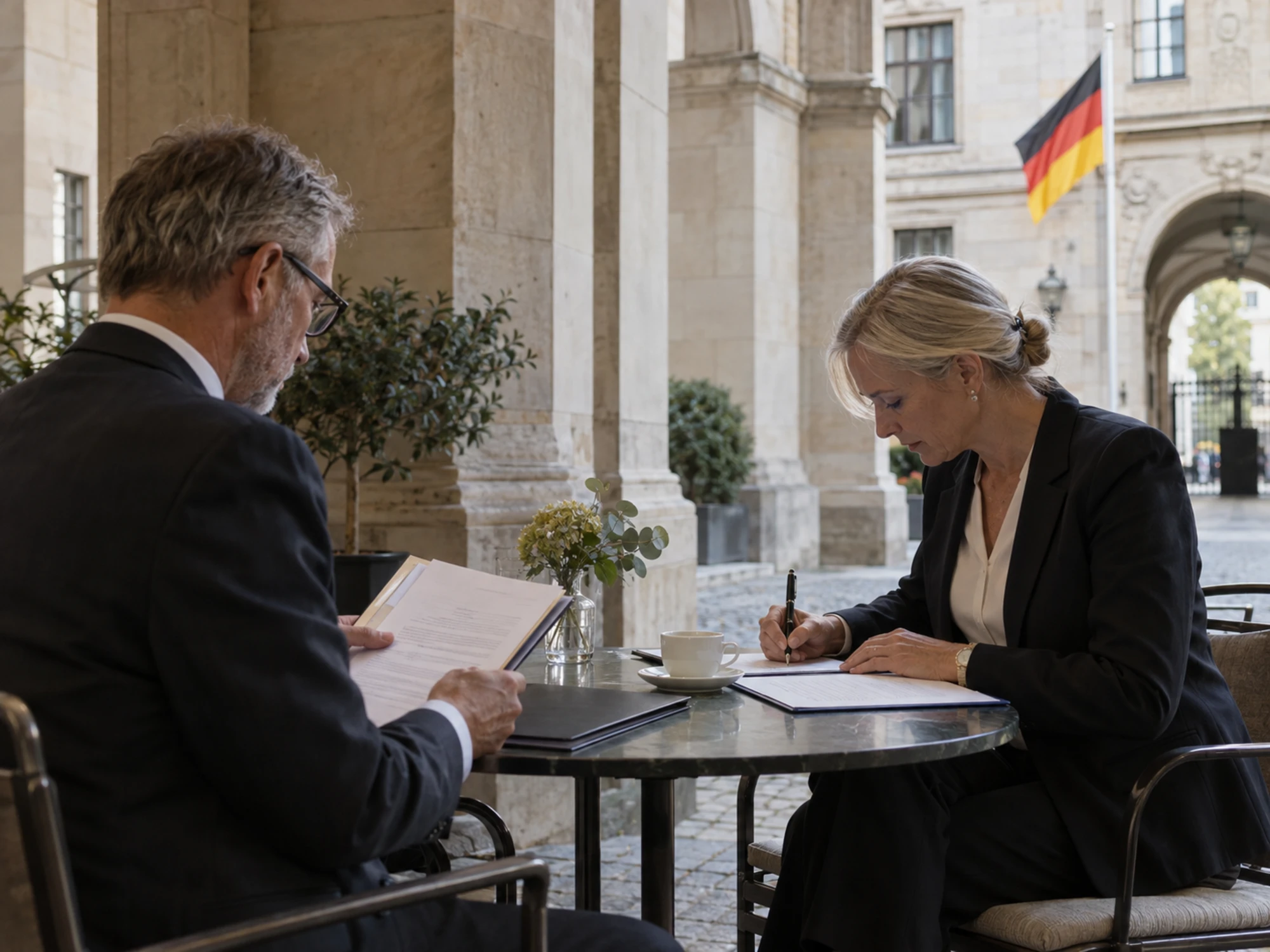
Some of what foreigners describe as German business culture is banking regulation. Under the MaRisk, a German bank separates the front office from the back office, and a credit decision needs two votes, one from each; the same four-eyes habit shapes how a bank signs off a vendor. Decisions therefore go through a committee, and a first meeting seldom ends with a commitment. Written follow-up with the agreed points is expected, and formal address with surname and academic title, such as Dr., is the default in a first meeting.
Setting up a company in Germany
Germany Trade & Invest, the federal economic development agency, helps foreign companies set up business in Germany, with information on company formation, corporate taxation, visas and incentive programs. A firm that only sells software to banks can start with a GmbH, a limited liability company; a regulated business needs its license first, as market entry Germany explains.
Upcoming Finance Loop events
What are the benefits of doing business in Germany for a fintech?
A large banking market within the EU, with the ECB, the Bundesbank and Deutsche Börse in Frankfurt and the Sparkassen and cooperative banks reachable through shared IT providers. A license from BaFin can be passported to the rest of the EU.
Do German banks buy from foreign fintechs?
Yes, if the vendor passes the outsourcing and DORA review and supports German standards. A pilot with one bank, presented by that bank at an event, makes the next sale easier.
Doing business in Germany with Finance Loop
Finance Loop is a professional network for emerging technologies in finance with more than 4,000 members. It runs events in Frankfurt, Munich, Berlin and Hamburg in four fields, Investment & Digital Assets, Payments & Digital Money, Digital Infrastructure & Sovereignty, and Risk & Compliance, and is built in collaboration with Frankfurt Main Finance and TechQuartier.
A company new to Germany can sponsor a webinar (EUR 2,500 net) and help set its agenda, sponsor a meetup (EUR 3,000 net) with a presentation slot of up to 20 minutes, host its own event (from EUR 7,000 net), become a partner with year-round benefits (Premium Partner from EUR 7,800 net a year), or join a delegation to events such as Frankfurt Digital Finance, with personal introductions from the Finance Loop team (EUR 1,200 net per person).
Doing business in Germany and Finance Loop
Finance Loop works with DZ BANK as an event and network partner. Its events bring fintechs together with banks and market infrastructure, for example at the Digital Finance Night Frankfurt.
Finance Loop is a professional network and has the goal of driving the adoption of emerging technologies in finance, such as AI, digital payments, cloud and blockchain solutions. Finance Loop helps its members build skills and personal networks in these fields: Investment & Digital Assets, Payments & Digital Money, Digital Infrastructure & Sovereignty, and Risk & Compliance.