
Market Entry Germany for Fintechs
For a fintech, market entry in Germany starts with one question: does the product need a license here, and if so, which one. An EU firm with a license at home can usually passport it; a UK, Swiss or US firm needs a license inside the EU. Payments, e-money, stablecoins, crypto custody and AI credit scoring each fall under different rules. Dated events are in the calendar below.
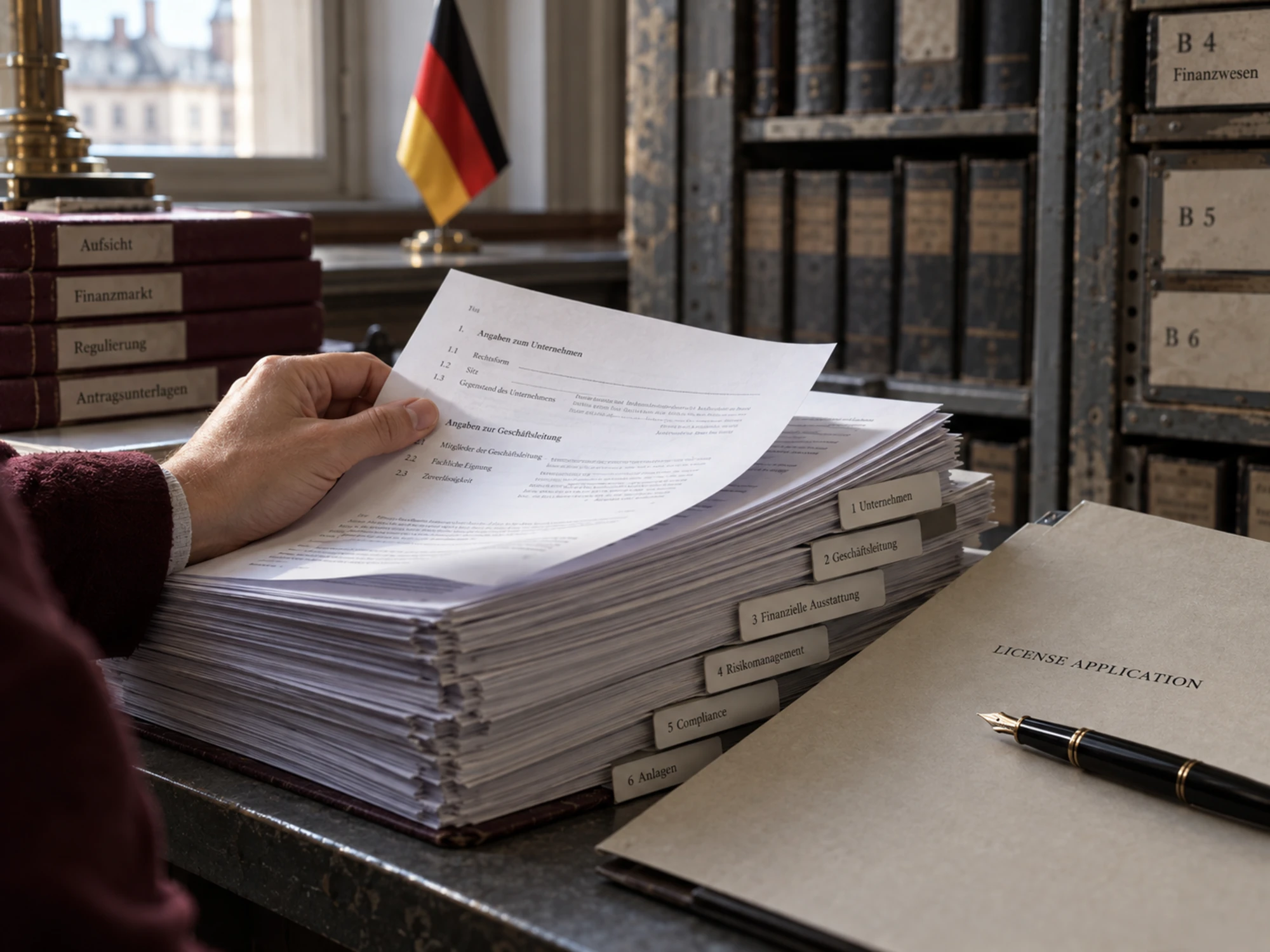
Which license the product needs
The business model decides the law. Deposits and lending need a banking license under section 32 of the Banking Act, with at least 5 million euros of capital and two fit and proper managing directors. Payment and e-money institutions are licensed under the Payment Services Supervision Act, with initial capital from 20,000 euros for money remittance to 350,000 euros for e-money. Crypto-asset services need a CASP license under MiCA. BaFin license lists the types. Once BaFin has a complete banking application, it has six months to decide. BaFin offers a fintech contact form for founders who are unsure whether their model needs a license; it does not give legal advice.
From another EU state: the passport
A firm licensed in another EU or EEA state notifies its home supervisor and can then serve German customers across the border, through a branch or, for payments, through agents. Under Article 28 of PSD2 the home authority forwards a complete notification within one month, and section 39 of the German Payment Services Supervision Act lets the firm work in Germany without a BaFin license. Under Article 65 of MiCA a crypto-asset service provider may start at the latest on the 15th calendar day after its notification. EU passporting has the details. The firm's marketing still has to follow German rules, such as the consent rules for email advertising.
From the UK, Switzerland or the US
A firm from outside the EU has no passport. It can apply for a German license, or license a subsidiary in another EU state and passport from there. For banking and financial services, BaFin can exempt firms from parts of the Banking Act under section 2(4) (in German) where they do not need its supervision, which matters for foreign firms that serve only professional clients across the border. A Swiss firm that holds a FINMA fintech license needs a separate EU authorization for German customers.
Selling to banks without a license
A software or data vendor that sells to banks usually needs no license of its own, but its customers pass their rules on to it. If the service supports a critical or important function, DORA sets what the contract must contain, and German banks run an outsourcing review under the MaRisk, described on outsourcing and cloud in German banking. The vendor should have its security documentation, exit plan and audit rights ready before the first pilot. Doing business in Germany covers how banks buy.
Setting up the company
Germany Trade & Invest, the federal economic development agency, helps foreign companies set up business in Germany, from company formation and taxes to visas and incentive programs. A firm licensed by BaFin has its head office in Germany; a passporting firm can serve German customers without a local company.
Upcoming Finance Loop events
Does a fintech need a BaFin license to enter Germany?
Only if its business is regulated and it has no EU passport. A payment or e-money institution licensed in another EU state can passport; a software vendor that sells to banks needs no license, but must meet its customers' outsourcing and DORA requirements.
How long does a BaFin license take?
BaFin has to decide on a banking license within six months of receiving a complete application. The clock starts only when business plan, capital, management and risk organization are all documented.
Where should a fintech start in Germany?
Where its customers are. Frankfurt has the ECB, the Bundesbank, Deutsche Börse and many banks; Berlin has the most fintechs; Munich has Allianz and Munich Re. Fintech in Germany compares the hubs.
Entering Germany with Finance Loop
Finance Loop is a professional network for emerging technologies in finance with more than 4,000 members. It runs events in Frankfurt, Munich, Berlin and Hamburg in four fields, Investment & Digital Assets, Payments & Digital Money, Digital Infrastructure & Sovereignty, and Risk & Compliance, and is built in collaboration with Frankfurt Main Finance and TechQuartier.
A company new to Germany can sponsor a webinar (EUR 2,500 net) and help set its agenda, sponsor a meetup (EUR 3,000 net) with a presentation slot of up to 20 minutes, host its own event (from EUR 7,000 net), become a partner with year-round benefits (Premium Partner from EUR 7,800 net a year), or join a delegation to events such as Frankfurt Digital Finance, with personal introductions from the Finance Loop team (EUR 1,200 net per person).
Market entry in Germany and Finance Loop
Finance Loop started in Frankfurt and brings fintechs together with banks, asset managers and supervisors at its events, for example the Digital Finance Night Frankfurt.
Finance Loop is a professional network and has the goal of driving the adoption of emerging technologies in finance, such as AI, digital payments, cloud and blockchain solutions. Finance Loop helps its members build skills and personal networks in these fields: Investment & Digital Assets, Payments & Digital Money, Digital Infrastructure & Sovereignty, and Risk & Compliance.