
Fintech in Stockholm and Copenhagen
Sweden and Denmark answered a question the rest of Europe is still working on: what happens to a payment system when people stop using cash. Both countries got there through a bank-owned mobile app, Swish in Sweden and MobilePay in Denmark, and both are now dealing with what the answer costs. The Riksbank's Payments Report recommends that Swedes keep about SEK 1,000 per adult in cash for a disruption, and that is the most instructive sentence written about Nordic payments in years.
Stockholm and Copenhagen share one page here because they share the story. The searches point at the same two hub organizations and the same two conference weeks, and a German bank or payment firm looking north has the same questions about both.
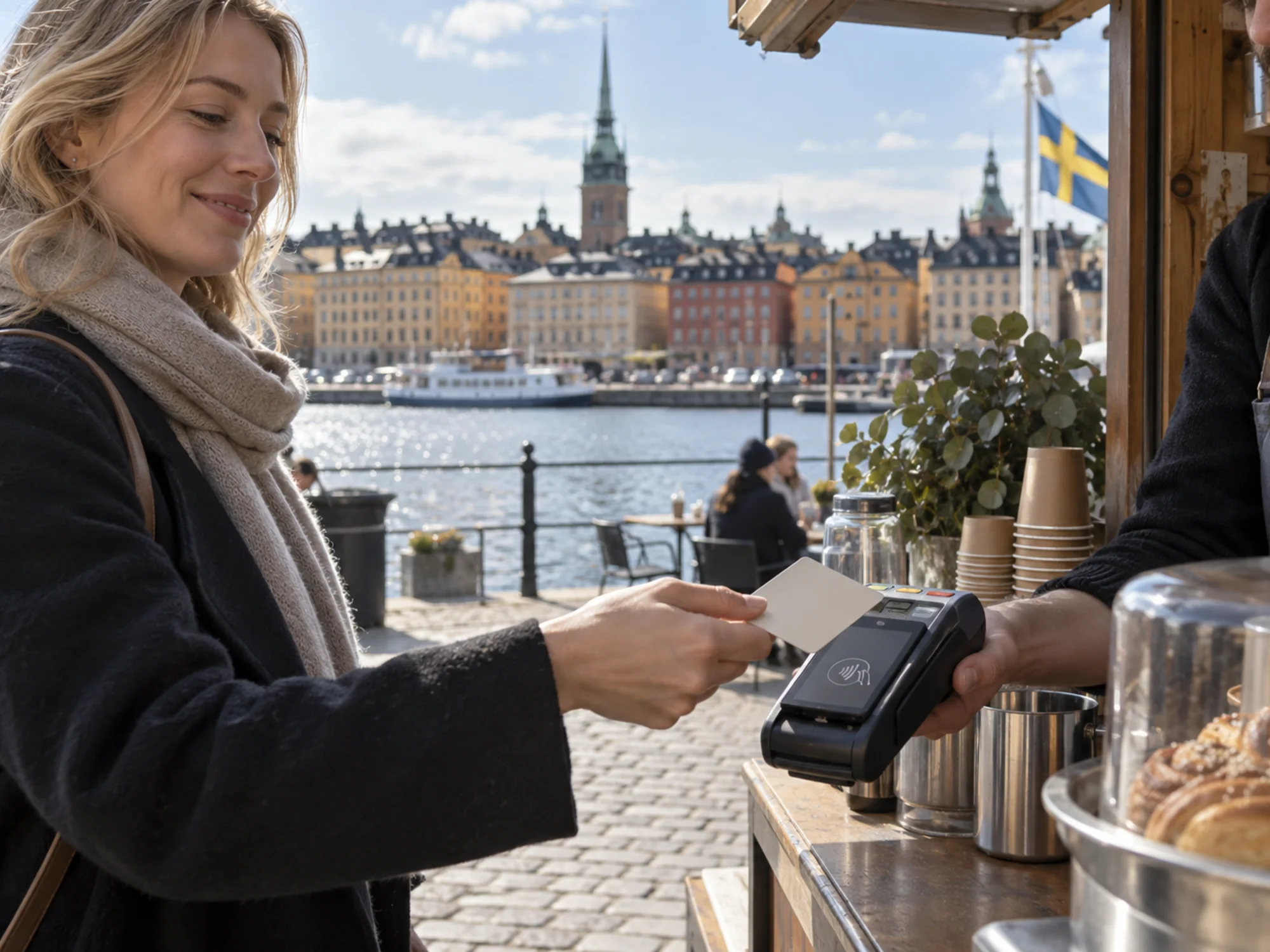
Swish and MobilePay: what the banks built together
Six of Sweden's largest banks launched Swish in 2012 through a joint company, Getswish AB, and its owners today include Swedbank, Handelsbanken, SEB, Nordea, Danske Bank, ICA Banken and Länsförsäkringar. The service moves money between phone numbers in seconds and reached more than eight million private users in a country of about ten million, along with several hundred thousand businesses. A Swedish market stall, a sports club collecting fees and a flea-market seller all take Swish, and that reach is the reason cash stopped being needed.
Denmark's answer was MobilePay, built by Danske Bank. In October 2022 the European Commission approved its merger with Norway's Vipps, and the combined company began operating in November 2022 with the Vipps owner banks holding 72.2 percent and Danske Bank 27.8 percent. The merged business covered Denmark, Norway and Finland with around 11 million customers and 400,000 merchant and online acceptance points. OP Financial Group's Pivo left the deal in September 2022 after the Commission raised competition concerns.
The lesson for a German reader is about ownership, not technology. Neither app came from a startup or a scheme; both came from the incumbent banks agreeing to build one thing together instead of competing on it. German banks built girocard and are building wero through the same logic, and the Nordic examples show what the model reaches when the banks hold the whole retail market between them. Finance Loop covers the European picture under payments in Europe and instant payments in Europe.
P27, and what a failed Nordic payment platform taught
The most useful Nordic payments story is the one that did not work. P27 Nordic Payments was a joint venture of six large Nordic banks, among them Danske Bank, Handelsbanken, Nordea, OP Financial Group, SEB and Swedbank, set up in 2018 to run one clearing platform for domestic and cross-border payments in several Nordic currencies. The European Commission cleared the merger. In April 2023 the venture pulled back its ambition, and in May 2023 it withdrew its clearing license application to Sweden's Finansinspektionen, saying the plan had grown too complex for the conditions it faced.
What the banks did instead is the part worth copying. The migration to ISO 20022 message formats went ahead on its own schedule, with SEB and Nordea setting target quarters in 2023, and the owner banks kept responsibility for the Swedish infrastructure while Bankgirot, the clearing system dating from 1959, stayed in service. A multi-currency, multi-country clearing house turned out to be harder than the standard it was going to carry.
Anyone planning a cross-border payment project in Europe has a precedent here, and it argues for separating the message standard from the infrastructure that moves the money. Finance Loop covers the subject under cross-border payments in Europe.
Finansinspektionen and Finanstilsynet
Sweden's supervisor is Finansinspektionen, which states its purpose as a stable, well-functioning financial market for all and organizes its work around consumer protection, financial stability, sustainability, banking, payments, insurance and markets. It runs an Innovation Center, the point of contact for a firm with a new model and an open question about which rules apply.
Denmark's supervisor is Finanstilsynet, the Danish Financial Supervisory Authority, which states its purpose as a resilient and reliable financial sector for everyone. It keeps its own fintech section with an FT Lab and a Fintech Forum, and the FT Lab lets a firm test a model under supervision before it goes to market.
Both authorities apply the same EU rulebook a German firm knows from BaFin, and the difference is in posture. A named innovation unit with a published entry point gives a founder a meeting, and that is a weaker promise than a legal exemption and a stronger one than a general mailbox. Finance Loop covers German supervision of digital assets under MiCA in Germany.
The e-krona and what a cashless country is afraid of
The Riksbank's e-krona work is the oldest central bank digital currency project in Europe, and it has not produced a decision. The Riksbank tested a technical solution in a pilot, published a series of e-krona reports, and runs an e-krona Dialogue Forum. In its Payments Report it recommends that the Riksdag and the government open an inquiry into an e-krona, so the decision sits with the legislature and no launch has been announced.
The same report explains why. Cash is rarely used in Sweden and the supply of cash services keeps shrinking, so the Riksbank recommends better access to cash services, proposes a SEK 10,000 limit for cash purchases in retail, and tells households to keep roughly SEK 1,000 per adult for a disruption. A country that removed cash from daily life found that it had removed its fallback, and resilience became a payments question instead of an IT question.
That is the argument Europe is having about the digital euro, with a different starting point: Germany still uses cash heavily, so the fallback case is weaker and the sovereignty case carries more of the weight. Finance Loop covers the comparison under CBDC in Europe and the European project under the digital euro.
Nordic open banking before PSD2, and what PSD3 changes
Nordic banks opened account access before the law told them to. Danske Bank offered an app showing accounts held at several banks, and Nordea built a developer portal for its open banking APIs that passed 3,300 registered users. When PSD2 took effect in September 2019 and obliged banks across the EU to open account access to licensed third parties with the customer's consent, the Nordic banks already had working interfaces and a commercial reason to keep them.
PSD3 and the Payment Services Regulation that accompanies it move the interface from a bank obligation to a supervised quality requirement, with explicit rules on availability and performance and a stricter line on obstacles in the consent flow. A bank that built its API as a product has less to redo than one that built it to pass an audit, which is why the Nordic head start still matters. Finance Loop covers the new framework under PSD3 and the German implementation of the old one under open banking in Germany.
Copenhagen Fintech and the hub organizations
Copenhagen Fintech describes itself as the innovation hub created to accelerate fintech innovation in Denmark and the Nordics, and it was set up in 2015 by leaders of the Danish financial sector. Its Copenhagen Fintech Lab, which it calls the meeting point of its community and the biggest center of Nordic fintech, has housed more than 120 startups and rents flexible desks. Copenhagen Fintech has organized Nordic Fintech Week since 2017.
Stockholm's counterpart was Stockholm Fintech Hub, an independent not-for-profit hub for Swedish fintech, insurtech and regtech firms that put regulators, investors and founders in one building. Its own domain no longer resolves, so a firm looking for a Stockholm entry point should start from the conference weeks and from Finansinspektionen's Innovation Center. Stockholm Fintech Week runs as the Swedish event, with a conference day and side events across the city.
Why is Sweden almost cashless?
Because the banks built one instant mobile payment that everybody accepts, and because Swedish retailers are allowed to refuse cash. Swish launched in 2012 with six large banks behind it and passed eight million private users, so a seller who takes Swish loses nothing by declining notes. The Riksbank now treats the result as a risk: its Payments Report records that cash is rarely used and cash services are shrinking, recommends better access to them, proposes a SEK 10,000 limit on retail cash purchases, and advises households to hold about SEK 1,000 per adult for a disruption.
Is Stockholm or Copenhagen the bigger fintech hub?
They do different things, and the ranking question misses it. Stockholm produced the large consumer-facing companies in payments and lending and draws the venture money that follows them. Copenhagen built the institution: Copenhagen Fintech was founded in 2015 by the Danish financial sector, has housed more than 120 startups in its Lab, and runs Nordic Fintech Week. A founder raising a growth round and a founder looking for a bank partner and a test environment are asking about two different cities.
Which Nordic conference should a German firm attend?
Nordic Fintech Week in Copenhagen if the goal is bank and institution contact, since Copenhagen Fintech has run it since 2017 and its membership is built from the Danish and Nordic financial sector. Stockholm Fintech Week if the goal is the Swedish company and investor scene, with a conference day plus side events across the city. Both are smaller than the Frankfurt and Amsterdam events, which makes the hallway conversations easier to get.
Do Nordic firms need a separate license for the EU?
Swedish and Danish firms are EU-licensed and passport into Germany like any other, so no second license is needed. Norwegian and Icelandic firms sit in the European Economic Area, which carries the same passport through the EEA Agreement, with the rules arriving after a delay while they are taken into the agreement. The practical gap is currency and not licensing: a firm built on the Swedish krona or the Danish krone handles euro settlement as a separate project, and that is the work P27 set out to spare it.
Nordic fintech and Finance Loop
Finance Loop brings the Nordic payments experience to the people in Germany who face the same decisions a few years later: whether a bank-owned app can carry a national market, what a payment system needs when cash is gone, and how much of a joint infrastructure project to attempt at once. Finance Loop is the Frankfurt meeting place for Payments & Digital Money and for Digital Infrastructure & Sovereignty, and a Swedish or Danish answer to one of those questions is worth more in the room than in a report.
Finance Loop is a professional network and has the goal of driving the adoption of emerging technologies in finance, such as AI, tokenization, stablecoins, and DeFi. Finance Loop helps its members build skills and personal networks in these fields: Investment & Digital Assets, Payments & Digital Money, Digital Infrastructure & Sovereignty, and Risk & Compliance.