
MT103: the SWIFT message for a customer payment
MT103 is the Swift message type for a single customer credit transfer: the format in which banks sent cross-border payments for their clients for decades. Since November 22, 2025, cross-border payments on Swift travel in the ISO 20022 format, where the pacs.008 takes the place of the MT103, as Eco summarizes from a BNY client notice. Banks and their clients still say "MT103" for the payment confirmation.
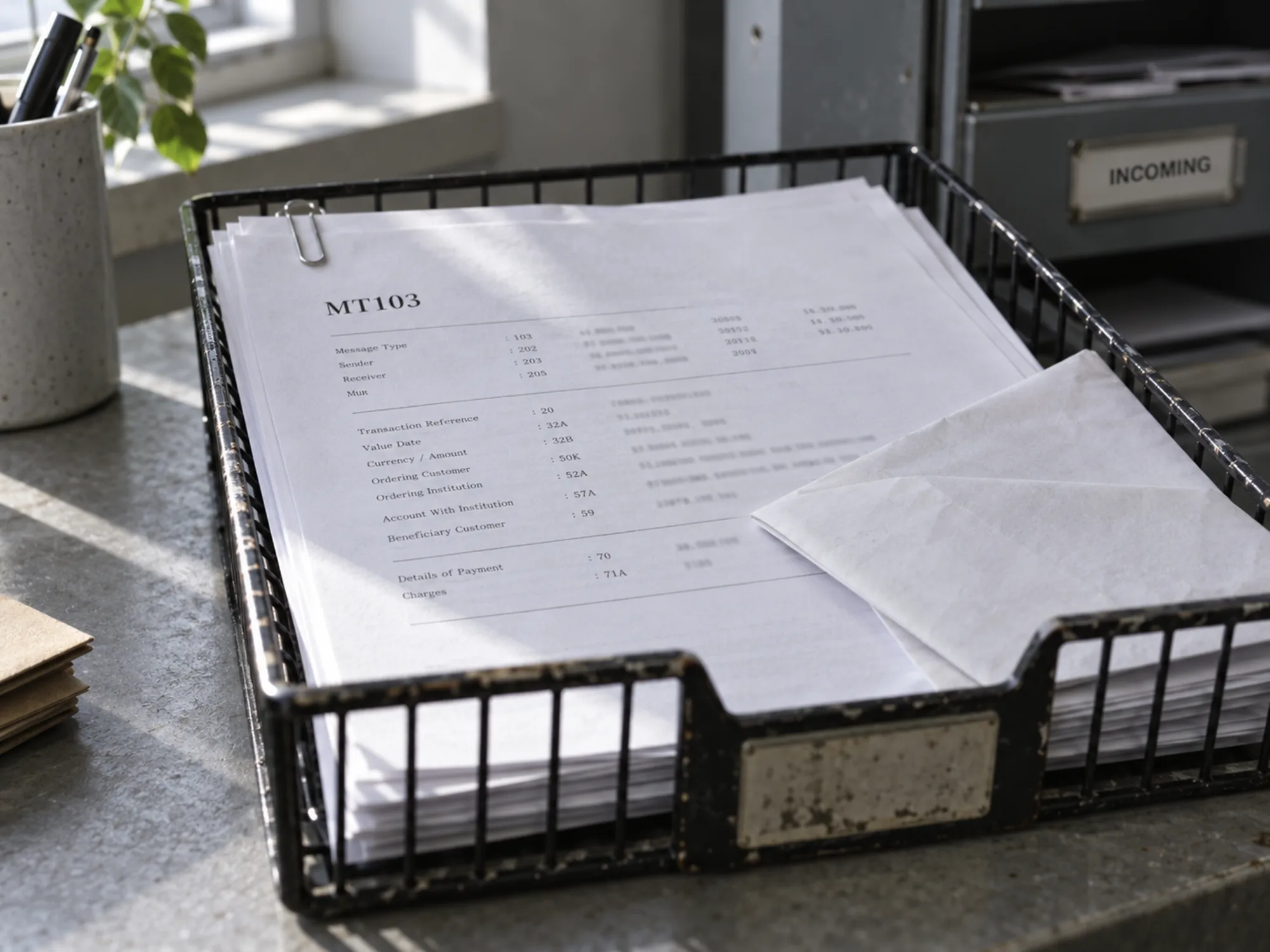
The fields of an MT103
An MT103 is a list of numbered fields. Field 20 holds the sender's reference, 23B the bank operation code, and 32A the value date, currency and amount. Field 50 names the ordering customer and 52 the ordering bank. Fields 53 and 54 name the correspondents of the sender and the receiver, 56 an intermediary bank and 57 the bank that holds the beneficiary's account. Field 59 is the beneficiary, 70 the remittance information, and 71A says who pays the charges: OUR, SHA or BEN. Field 72 carries notes from bank to bank and 77B regulatory reporting, according to the field list of Ohmyfin.
The weakness of the format sits in fields 50, 59 and 70: names, addresses and invoice references went in as free text over a few lines, and every bank filled them its own way. That is what the structured fields of ISO 20022 replaced.
MT103 and MT202 COV
An MT202 moves money between two banks for their own account. When a bank pays with the cover method, it sends the MT103 straight to the beneficiary bank and moves the funds separately through the correspondents with an MT202 COV. The COV variant repeats the details of the underlying customer payment, so every bank in the cover chain can screen who pays whom. A field 54 in an MT103 points to such a cover payment.
In ISO 20022 the MT103 maps to the pacs.008, the MT202 to the pacs.009, and the MT202 COV to the pacs.009 COV, as the hub answer on how cross-border payments work lists.
From MT103 to pacs.008
The fields carry over with new names. Field 50K becomes the Debtor, 59 the Creditor, 70 the Remittance information, and 71A the Charge bearer with the codes DEBT, SHAR and CRED. The UETR, which sat in field 121 of the MT header, has its own element. What changes is the depth: the debtor's address has a street, building number, postcode, town and country of its own, and the remittance data can be structured. The page on ISO 20022 migration follows the deadlines that remain.
Fake MT103 copies
Because an MT103 copy counts as proof that a payment was sent, fraudsters forge it. The Bank of Namibia warned that perpetrators send victims a fake MT103 to show that money has been deposited and then ask for upfront fees, and stated that only banks and financial institutions issue MT103 payment instructions, as New Era reported. Offers of an "MT103 cash transfer" follow the same advance-fee pattern. A genuine MT103 also proves only that a payment left the sending bank. The money has arrived when your own bank has credited it.
Finance Loop covers the wider pattern in APP fraud and financial crime in payments.
Upcoming payments events
Is the MT103 still used?
Not on the Swift network for cross-border customer payments, which run as pacs.008 since November 22, 2025. Banks still issue a confirmation they call MT103 copy, and some domestic or closed systems still use MT formats.
What is an MT103 copy?
A printout of the payment message from the sending bank. It shows payer, beneficiary, the banks in the chain, amount, value date and who pays the charges. It proves that the payment was sent, not that it was credited.
What is the difference between MT103 and MT202?
The MT103 is a payment for a customer, with payer and beneficiary. The MT202 is a transfer between banks for their own account. The MT202 COV is the cover leg of a customer payment and repeats the customer details.
MT103 and Finance Loop
Finance Loop is the meeting place for the payments operations, compliance and treasury teams in Germany that send and receive payments over Swift. Finance Loop supports When Banks Say 'No', a Frankfurt seminar on sanctions, de-risking and international payment flows, with speakers from Dentons and A|Q FORENSICS.
Finance Loop is a professional network and has the goal of driving the adoption of emerging technologies in finance, such as AI, digital payments, cloud and blockchain solutions. Finance Loop helps its members build skills and personal networks in these fields: Investment & Digital Assets, Payments & Digital Money, Digital Infrastructure & Sovereignty, and Risk & Compliance.