
Financial wellbeing
Financial wellbeing describes how people manage current financial commitments, withstand unexpected expenses and make choices about their future. For banks and fintechs, that creates a product question: which digital services help customers exercise that control, and what evidence supports the result?
A banking app can organize transactions, explain a decision or offer timely support. Evaluating those functions requires an agreed customer outcome before the team chooses features, data sources or commercial targets.
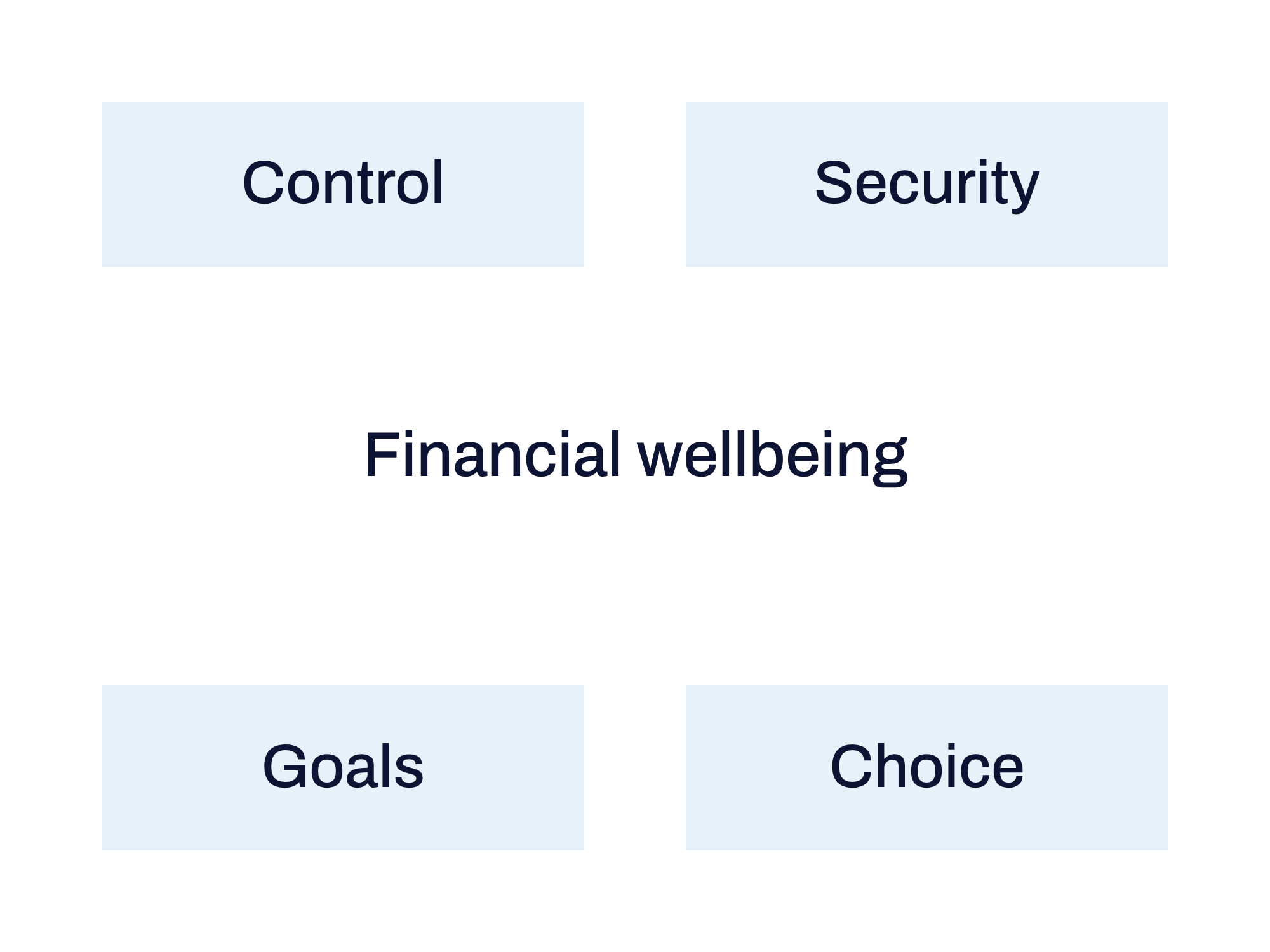
What financial wellbeing means
The CFPB framework covers everyday control, resilience to financial shocks, progress toward goals and freedom of choice. These dimensions describe financial circumstances and the experience of living with them.
A product team can translate the framework into explicit research questions. Can customers understand what remains available after upcoming commitments, and can they change a plan when circumstances change? Interview findings should distinguish difficulty understanding the interface from insufficient income or unavoidable costs. Those problems require different responses, even when they appear within the same customer journey.
From customer needs to digital services
Start with one decision that the customer needs to make successfully. A cash-flow view might explain expected bills before the next income payment. A savings function might let customers choose a target and revise contributions without losing their previous progress. A support journey might help someone reach assistance after reporting payment difficulties.
For each function, write down the expected customer benefit and a plausible failure. A reminder could arrive after a payment has already been made, while an automated transfer could leave too little money for essentials. Product requirements should include correcting inaccurate information and changing or stopping the function. These are proposed evaluation cases, whose usefulness depends on the actual service and customer research.
Measuring financial wellbeing
The CFPB Financial Well-Being Scale measures perceived financial security and freedom of choice through a structured questionnaire. Its published materials include standard and abbreviated versions with scoring instructions. Teams using this instrument should follow the relevant method and document the questionnaire version.
For product evaluation, pair the chosen outcome measure with a clear description of the intervention. Record who was eligible, who participated and when the measurement occurred. Transaction activity can help explain how a function was used, while survey responses answer different questions about customer experience. Treat survey participation and missing account data as limitations when interpreting the results.
Permissions and understandable data use
List the information each function needs before asking customers to connect accounts. For example, a balance view and transaction categorization have different data requirements. The Stripe Financial Connections API makes requested data permissions explicit when creating a connection session. That implementation provides a useful reference for separating access requests by purpose.
Apply that principle to the actual banking infrastructure and supported markets. Explain what the service uses, how frequently information changes and how customers can stop sharing it. A product review should test the experience when permission is refused or a connection expires. The remaining interface should describe its limits without presenting incomplete information as a complete financial picture.
Evaluating customer outcomes
A pilot needs a starting measurement and a specified follow-up period. Choose a customer outcome that corresponds to the function being tested, and record the same measure consistently. A clearer explanation of bills might be assessed through comprehension tasks and reported control over upcoming payments.
Track commercial measures separately, so increased product use does not automatically become evidence of improved wellbeing. A comparison group can help examine whether observed changes also occurred without the intervention. Report recruitment and dropout alongside results, including customers who stopped using the service. Changes in household circumstances can affect the outcome during the evaluation period. A pilot report should explain those uncertainties before recommending wider deployment.
Interpreting findings across European markets
The G20 policy note from the OECD connects financial wellbeing with broader economic and social conditions. It presents a working definition and a preliminary approach to measurement.
For a European rollout, review language comprehension and local financial circumstances before comparing results across countries. Keep the questionnaire, recruitment method and observation period visible in every comparison. Translated wording should preserve the question while being understandable to participants. A score collected from one customer segment cannot describe every customer in another market. Product teams can use local interviews to investigate differences before treating them as product effects.
HoFT research and professional exchange
The House of Finance and Tech Berlin organizes its financial wellbeing framework around control, security, freedom and planning. Its research provides a starting point for discussion between financial institutions and technology providers.
Teams exploring these subjects can distinguish an organization describing its approach from independent evidence that a particular product improves outcomes. A useful professional discussion starts with the customer problem, the proposed intervention and the evidence still needed. Finance Loop connects professionals across European markets, with Central Europe as its current regional focus.
Related product subjects
Discuss financial wellbeing in digital products
Contact Finance Loop to discuss professional exchange around customer outcomes in digital financial services. Describe your product question and the expertise you want to meet across European markets.
Financial wellbeing and Finance Loop
Finance Loop is a European professional network for emerging technologies in finance. Finance Loop connects professionals through curated expert networks, education and introductions across these fields: Investment & Digital Assets, Payments & Digital Money, Digital Infrastructure & Sovereignty, and Risk & Compliance.