
Regulatory change management
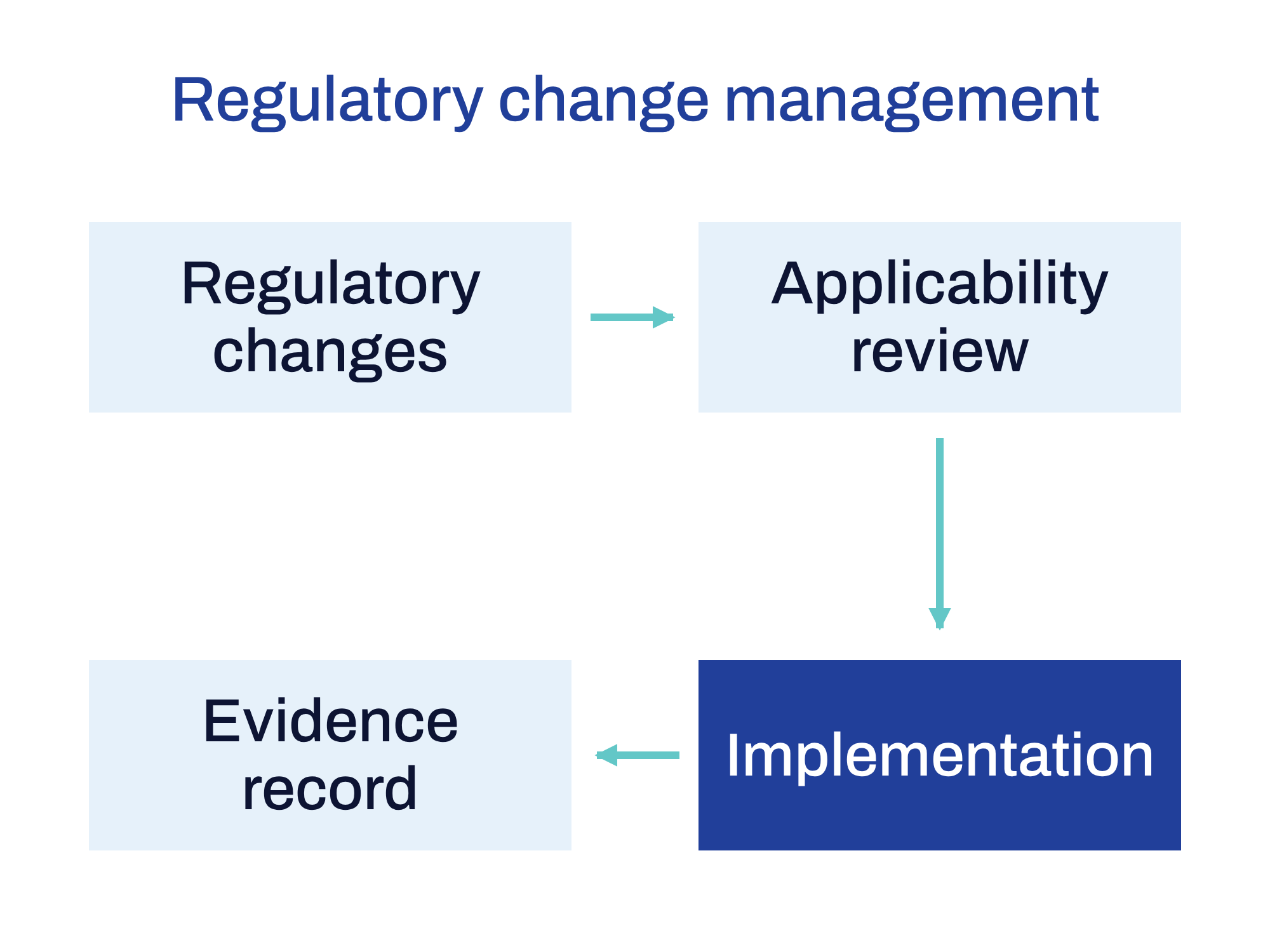
Regulatory change management connects new financial rules with decisions about a business and its controls. Compliance teams identify changes, assess their relevance and coordinate the work needed before applicable deadlines. AI can support document analysis and comparisons, while qualified staff approve interpretations and implementation decisions.
For institutions operating across Europe, the practical challenge is connecting each change to the right legal entities, products and responsible teams. A useful process preserves the original source, the applicability decision and the evidence of completed action. This creates a record that colleagues can review when requirements or business activities change.
Horizon scanning and source control
Regulatory horizon scanning starts with a defined collection of authorities, publications and jurisdictions. Each incoming item should retain its publication date, document version and original source address. A consultation, an adopted measure and an applicable obligation need separate statuses because they trigger different decisions.
Teams should distinguish the date a measure enters into force from any later application or transitional dates. A correction or replacement document must remain connected to the earlier version. Monitoring coverage also needs an owner who reviews missing sources and interruptions in collection.
Applicability across entities and activities
An assessment should connect the regulatory text with the institution's licenses, activities and operating countries. A rule affecting one subsidiary may not apply identically to every group entity. Product changes, new markets and acquisitions can also make a previous exclusion outdated.
AI classification can propose relevant topics and potentially affected business areas for review. The reviewer should record the scope, reasoning and source passages behind the decision. Uncertain cases need an assigned specialist, a review date and documented closure decisions.
AI analysis with traceable evidence
CUBE RegPlatform uses AI classification to support applicability assessment using jurisdiction, entity type and business activity. The regulatory change workflow in CUBE RegPlatform also connects obligations with ownership and deadlines. These capabilities illustrate a product approach whose suitability depends on configuration and institutional review.
A buyer should test whether generated summaries preserve exceptions, definitions and transitional provisions. Every proposed obligation should lead back to the specific passage supporting it. Reviewers need a visible distinction between quoted evidence, generated interpretation and their approved conclusion.
Mapping obligations to policies and controls
A regulatory obligation may affect several policies, procedures and operational controls simultaneously. Teams need stable references connecting the obligation to the relevant documents and control owners. Updating a policy alone may leave an affected customer process or reporting workflow unchanged.
The Corlytics Compliance Dashboard connects obligations, policies and controls through configurable document relationships. Using the Corlytics Compliance Dashboard requires relevant permissions and an enabled Connections feature. During evaluation, institutions should test how those relationships survive document revisions and access restrictions.
Ownership and implementation decisions
A change record should separate legal interpretation, operational delivery and approval responsibilities. For significant institutions, the ECB governance assessment examines responsibilities and internal control functions, including compliance and internal audit. That supervisory context does not prescribe one universal software workflow for every financial business.
The responsible business team should agree on concrete deliverables, dependencies and acceptance criteria. A reviewer then confirms whether the evidence supports the proposed completion decision. Delayed actions need a documented escalation route that reaches the appropriate decision maker.
Testing a regulatory change workflow
A pilot should use previously assessed changes alongside documents that have not been classified. Include a consultation, a final rule, a correction and an item outside the institution's scope. Qualified reviewers should establish expected outcomes before comparing results with the proposed system.
Test missed obligations, unsupported interpretations and incorrect deadlines as separate failure types. A correct summary does not establish that the system identified every affected control. Review the handling of conflicting passages, translated documents and changes requiring several business owners.
Selecting software and integration partners
Regulatory change management software should fit the existing policy repository and governance processes. Buyers should verify source coverage, supported languages, permission controls and available export formats. They also need to establish which decisions remain available when a vendor contract ends.
The broader European RegTech market covers several distinct compliance functions, so a general platform description cannot establish change-management suitability. Ask providers to demonstrate one relevant change from receipt through approved implementation. The demonstration should include an incorrect recommendation, a correction and the resulting history.
Measuring progress and keeping evidence
Useful measures include time to initial assessment, overdue implementation actions and decisions returned for correction. Teams should also sample items classified as irrelevant to detect missed obligations. Comparisons require a consistent scope because a changing source collection can alter workload substantially.
The evidence record should connect each approved decision with its supporting source and implementation result. Record who approved the outcome and which version of the underlying obligation was assessed. Retention and access arrangements should follow the institution's applicable obligations and internal information policies.
Regulatory technology and AI governance
Regulatory change management and Finance Loop
Finance Loop connects financial institutions, technology providers and specialists working with emerging technologies across Europe. The professional network at Finance Loop supports relationships between people evaluating regulatory analysis, governance and implementation approaches. Central Europe is the current regional focus within this cross-border network.
Compliance leaders and technology teams can contact Finance Loop about relevant expert introductions and opportunities for professional exchange. Describe the countries, business activities and decisions involved so that the conversation starts with a clear institutional need.