
The Future of AI in Financial Services in London
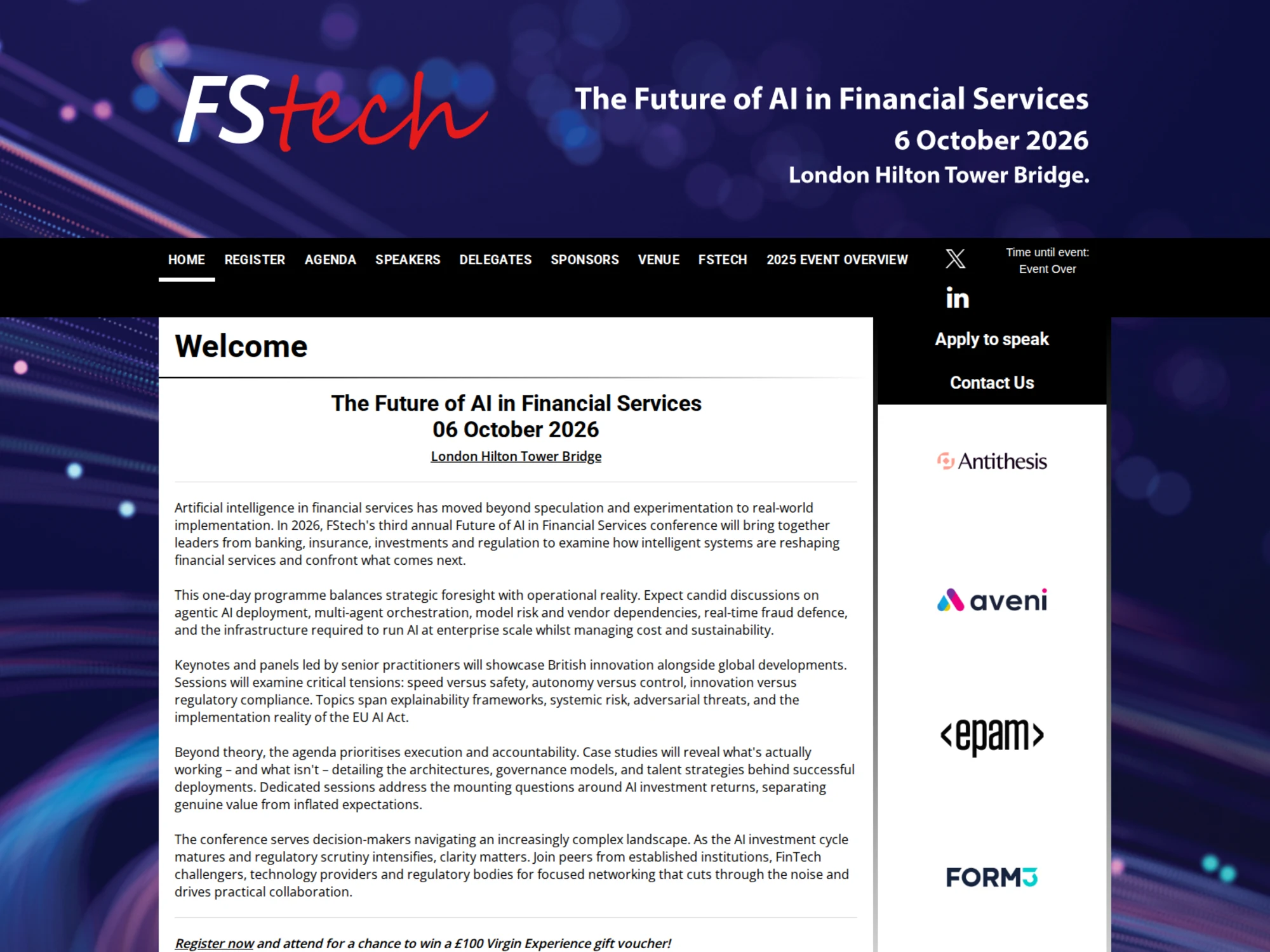
The Future of AI in Financial Services is the FStech conference for banks, insurers and asset managers that already run AI in production and now have to govern it. The next edition takes place on October 6, 2026 at the London Hilton Tower Bridge. If your job is to answer for a model when it fails, this agenda is written around that problem.
Who organizes the conference
The organizer is Perspective Publishing Limited, the publisher of the trade title FStech, which reports on technology in financial services. A publisher-run conference draws its speakers from the newsroom's contact book, so the sessions tend to come from named institutions rather than from vendors with a slot to fill.
The organizer states no attendance figure for the event. It is a single-day conference, which keeps the program tight compared with the multi-day fairs.
What the program covers
The organizer's agenda names agentic AI deployment and multi-agent orchestration, model risk and vendor dependencies, real-time fraud defense, and the infrastructure needed to run AI at enterprise scale. Explainability frameworks, systemic risk and adversarial threats follow, together with what the organizer calls the implementation reality of the EU AI Act.
That list is the governance half of AI work, which is why risk, compliance and technology leaders attend together. Finance Loop covers the same subjects on its pages for the EU AI Act in finance, generative AI in finance and fraud prevention.
Why vendor dependency is on the agenda
A bank that builds on a model it does not control has an outsourcing problem as much as a technical one, and European supervisors treat it that way. The organizer puts vendor dependencies next to model risk for that reason: the question of what happens when a provider changes a model version is now a resilience question, and Finance Loop treats it on its page about ICT third-party risk management.
Agentic systems sharpen the same point, because an agent that acts on its own takes decisions that a log has to reconstruct afterwards. That is the practical reason the conference pairs orchestration with explainability in one program.
When is The Future of AI in Financial Services?
The next edition takes place on October 6, 2026 at the London Hilton Tower Bridge, as the organizer's website states. The conference has run in London in the autumn in its previous editions, which places it after the September conference wave.
How does it differ from a technical AI summit?
This conference starts from governance and operations, while a technical summit such as the AI in Finance Summit starts from method. A team that needs both usually sends its model owners to one and its risk and compliance people to the other. The overview of AI finance conferences in Europe sets the two against each other by subject.
What does the EU AI Act mean for the agenda?
The EU AI Act gives the conference its compliance thread: a credit scoring model and an insurance pricing model fall into its higher-risk categories, so documentation, human oversight and testing become auditable duties. A UK-based conference still treats it as central, because most of the institutions in the room serve European clients and run European subsidiaries.
The Future of AI in Financial Services and Finance Loop
Finance Loop is the meeting place for AI governance in European finance: its members own models at banks and insurers, sit on the risk side that challenges them, and run the audits that follow. Finance Loop covers the conference's subjects in its Risk & Compliance track, from model risk to the EU AI Act.
Finance Loop is a professional network and has the goal of driving the adoption of emerging technologies in finance, such as AI, tokenization, stablecoins, and DeFi. Finance Loop helps its members build skills and personal networks in these fields: Investment & Digital Assets, Payments & Digital Money, Digital Infrastructure & Sovereignty, and Risk & Compliance.