
AI finance conferences in Europe
Conferences on AI in banking, finance and insurance now split into two camps, and sending the wrong person to the wrong one wastes a travel budget: one camp deals with method and deployment, the other with governance and model risk. This page explains how the European field is organized, so you can match an event to the decision in front of you.
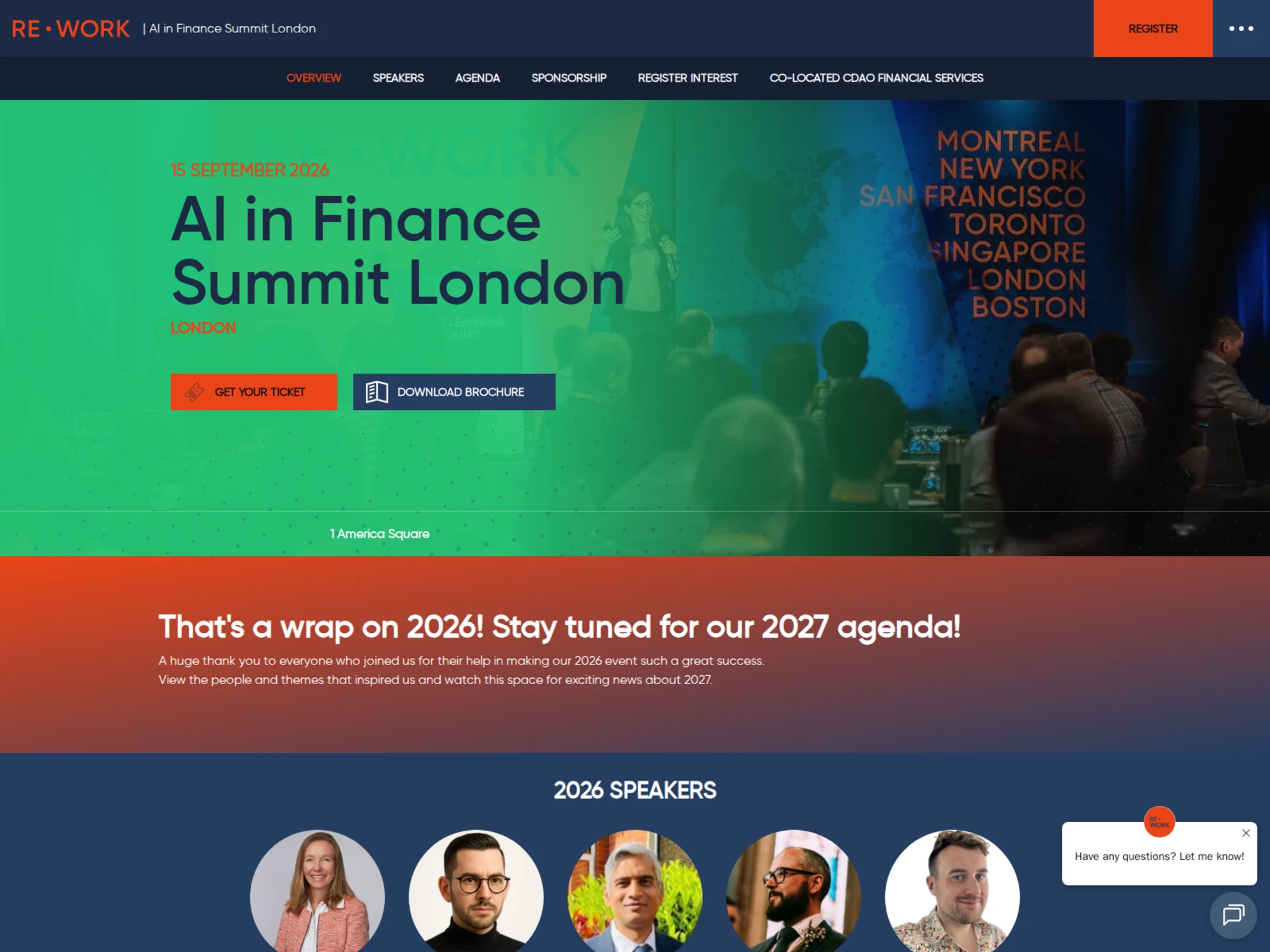
Technical summit or governance conference
The technical summit addresses data scientists, machine learning engineers and CTOs. Its sessions cover method, evaluation and the path to production, and the AI in Finance Summit in London is built that way. Send a model owner or a data science lead there.
The governance conference starts from the duties that follow once a model runs: model risk, vendor dependency, explainability and the EU AI Act. The Future of AI in Financial Services by FStech takes this shape. Send the risk, compliance and audit side, which has to defend the model rather than build it.
Where AI appears inside a finance conference
A third route is cheaper in travel: the large finance fairs carry AI as a track. Money20/20 Europe runs AI sessions through its payments and banking program, from underwriting to fraud defense, so a payments team gets both subjects in one trip.
In the German-speaking market the same mixing happens at the digital finance events, and the VI3NNA Congress in Vienna puts AI, finance and Web3 on one agenda. The KI Exchange serves the German AI audience across industries, with a finance share.
Which cities carry the field
London holds the densest program, because the quantitative teams, the asset managers and the supervisors who question their models are in one city. Frankfurt carries the German institutional side, where the search terms point at local events: AI in Frankfurt describes what the city offers, and Finance Loop runs its own sessions there.
Amsterdam carries the payments angle, Paris the research and startup side, and Vienna and Zurich the Austrian and Swiss institutional markets. For an insurer the relevant dates often sit at the industry's own conferences rather than at an AI event, because the pricing and claims questions are specific to the sector.
What is the best AI in finance conference in Europe?
There is no single best one, because the two camps answer different questions: a team that needs implementation detail goes to a technical summit, a team that owes a supervisor an answer goes to a governance conference. Many institutions send people to both in the same autumn. If you can travel once, pick the camp that matches the decision that is actually pending.
Are these conferences worth it for a bank?
They pay off when the question is how a peer solved something, since implementation detail rarely reaches a published case study. A head of data science learns more from a half-hour conversation about monitoring in production than from a vendor demonstration. They pay off less as a general introduction, which a course or a reading list covers more cheaply; Finance Loop teaches generative AI in finance in its own sessions.
What should be on an agenda in 2027?
Agentic systems and their logging, because an agent that acts alone has to be reconstructable afterwards. Vendor dependency and model versioning, which European supervisors treat as a resilience question, covered under ICT third-party risk management. Real-time fraud defense, treated on fraud prevention in Germany. An agenda without these reads as a program from an earlier year.
AI finance conferences in Europe and Finance Loop
Finance Loop is the meeting place for AI in European finance: its members build and govern models at banks, insurers and asset managers, and they decide together which conference is worth the trip. Finance Loop runs its own AI sessions for finance professionals between the large dates and covers the subject from model risk to portfolio work.
Finance Loop is a professional network and has the goal of driving the adoption of emerging technologies in finance, such as AI, tokenization, stablecoins, and DeFi. Finance Loop helps its members build skills and personal networks in these fields: Investment & Digital Assets, Payments & Digital Money, Digital Infrastructure & Sovereignty, and Risk & Compliance.