
Personal financial management
Personal financial management, or PFM, is software that organizes account transactions into a usable picture of income and spending. Banks and fintechs embed these functions in their digital services so customers can review spending categories, set budgets and follow financial goals within an existing banking relationship.
For product teams, the practical decisions concern the information behind each calculation and the control customers retain over it. Account coverage, transaction categorization and the handling of corrections determine whether a budget reflects the individual customer, while clear explanations help customers understand estimates and incomplete information.
Personal financial management software in banking
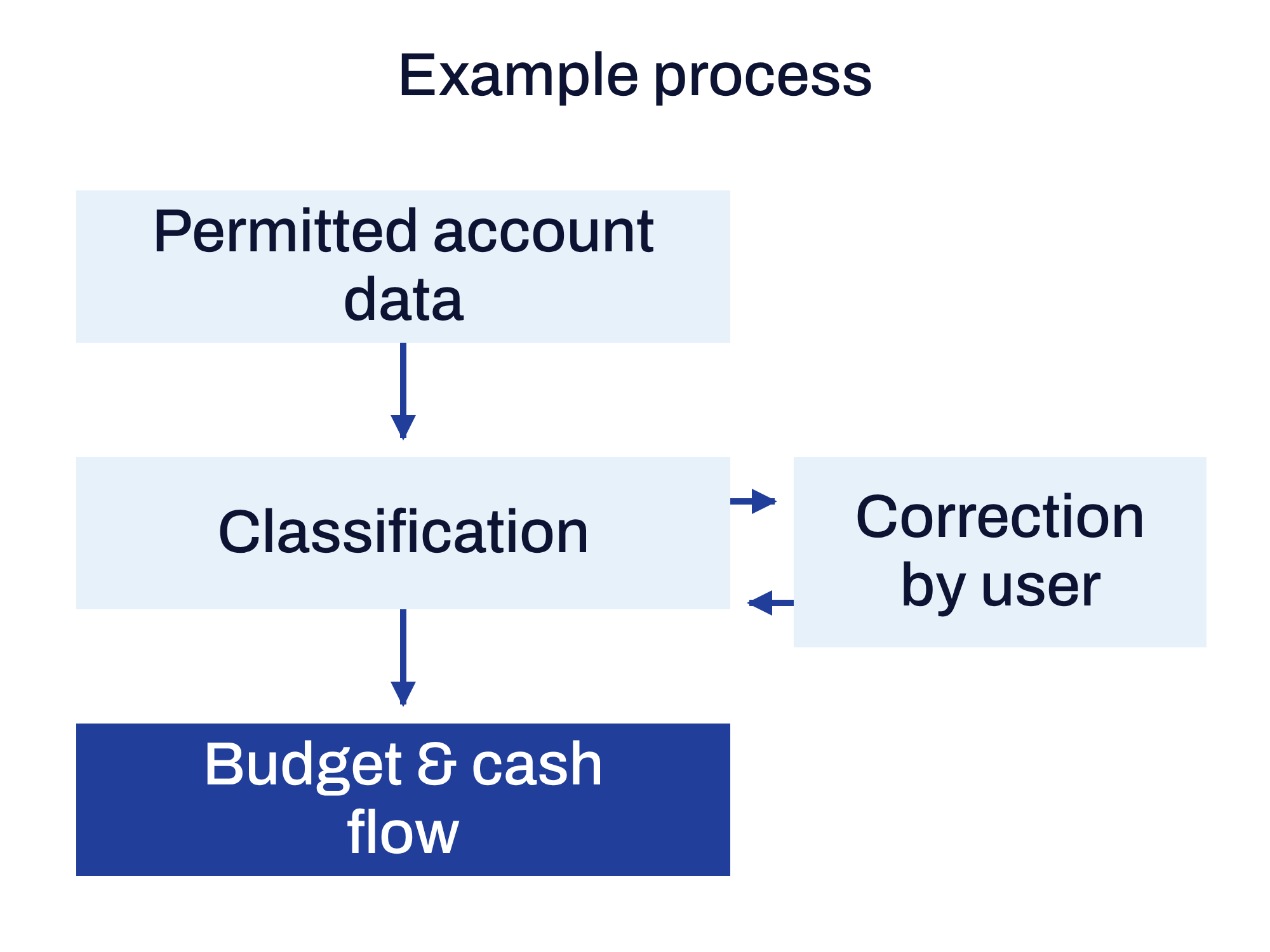
A PFM implementation brings together transaction records, analytical rules and a customer interface. The bank first defines which accounts belong in the overview, then explains which spending and income the analysis includes. A customer with several accounts needs to understand whether the view covers one institution or connected accounts elsewhere.
Tink provides a concrete implementation example through its modular Consumer Engagement offering, formerly called Money Manager. Its Finance Management functions cover statistics, budgets and savings goals alongside subscription and bill management through an API. Buyers should compare the modules they actually need and confirm their availability within the proposed integration.
Transaction categorization and customer corrections
Transaction categorization assigns income and expenses to groups that support meaningful comparisons over time. The classification must remain understandable when a merchant description is ambiguous or one payment includes different purchases. Teams should test refunds and transfers between personal accounts, since their treatment can change the apparent spending total.
BoursoBank documents customer corrections to automatically assigned categories within its budget service. Customers can optionally apply a changed category to similar existing and future transactions. This provides a practical acceptance case: verify the correction itself, its effect on the spending chart and the scope of any rule saved for subsequent transactions.
Budgets and cash flow estimates
A budget compares spending against an amount chosen for a period or category. A cash flow estimate also considers when income and payments are expected to arrive. Product teams should display the calculation period and explain whether an amount comes from booked transactions, expected payments or assumptions about future behavior.
Money Manager includes category budgets and a Left to Spend function based on income, expenses and historical patterns. In an acceptance test, changing a recurring payment should produce an understandable change in the estimate. Irregular income and an unexpected bill belong in the same test set, since previous transactions cannot guarantee future available funds.
Account coverage and data permissions
Account aggregation determines the information a PFM service can analyze across institutions. Multibanking connects accounts at different banks, while the PFM decision concerns what customers can understand and change after data arrives. A product review should include the account selection, the last successful update and the behavior when a connection stops supplying transactions.
The HVB Finanzmanager illustrates a defined account scope: it covers customers' own HVB accounts and credit cards, excluding business accounts and accounts held under authorization. Targeted advice or individual offers using these data require separate additional consent beyond the budgeting service. These documented limits provide concrete questions for comparing another implementation without assuming identical product conditions.
Evaluating a personal financial management application
Start a product trial with agreed customer scenarios and a small set of observable outcomes. Ask participants to find a recurring expense, correct a category and explain the remaining budget using the displayed information. Record incomplete tasks and misunderstood amounts alongside technical errors, because a successful data connection alone does not establish usable financial information.
Then compare results across customers with different account combinations and income patterns. Track whether corrections persist after the next update and whether reminders remain useful when circumstances change. These are proposed product evaluation criteria, and improvements in engagement should be measured separately from changes in customers' financial circumstances.
Financial control and the limits of transaction data
The HoFT workplace research places budgeting tools within a broader discussion of financial wellbeing support. For banking product teams, this context raises a useful distinction between providing an account overview and establishing whether customers feel financially secure. Transaction categories reveal recorded activity, while financial wellbeing also involves experiences that account data alone cannot describe.
A PFM roadmap can therefore connect spending information with clear explanations and customer support. Product owners should state what the service calculates and identify where a customer can obtain further help. A planning function should not be presented as evidence that a particular investment or credit product suits an individual customer.
Banking data and products
Personal financial management and Finance Loop
Finance Loop is a European professional network for emerging technologies in finance, with a current regional focus on Central Europe. Through its events and professional relationships, Finance Loop connects people discussing banking products, financial data and customer services across these fields: Investment & Digital Assets, Payments & Digital Money, Digital Infrastructure & Sovereignty, and Risk & Compliance.