
Stablecoin AML and compliance
A stablecoin moves like cash between wallets and like a wire transfer between regulated firms. AML rules attach to the firms at each end: the issuer, the exchange or custodian, and the bank that pays out. Dated events are in the calendar below.
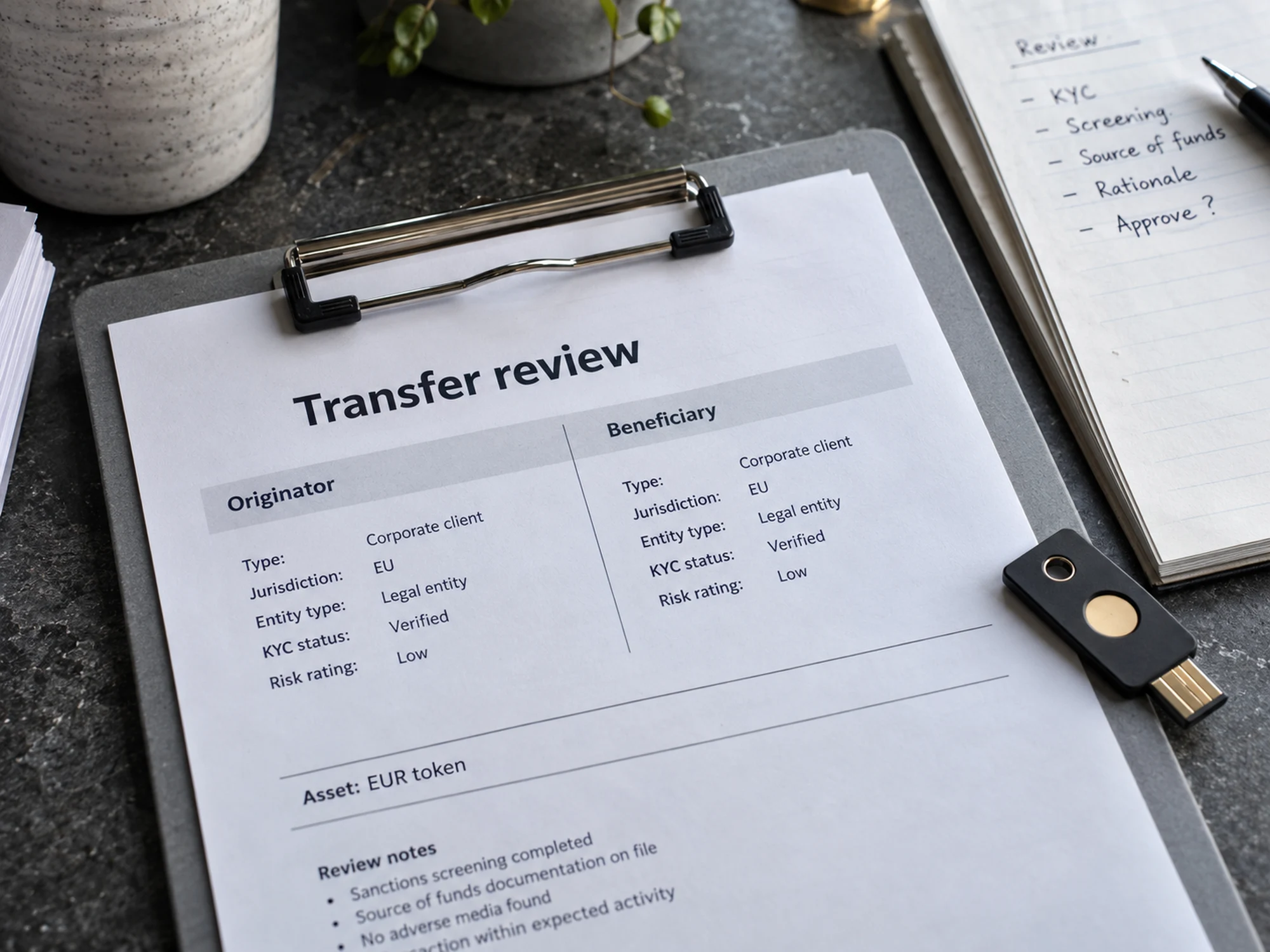
The travel rule in the EU
Regulation (EU) 2023/1113 extends the duty to send originator and beneficiary data with a transfer from banks and payment firms to crypto-asset service providers. The EBA travel rule guidelines apply from December 30, 2024. They say which information must travel with a transfer of funds or crypto-assets, how firms detect missing data and what they do when it is missing, and how they assess the risk of transfers to and from self-hosted addresses. A stablecoin transfer between two exchanges therefore carries the same kind of data as a SEPA transfer. The travel rule answer explains the mechanics.
Stablecoins in the FATF's findings
The Financial Action Task Force published a Targeted Report on Stablecoins and Unhosted Wallets, 42 pages built on more than 50 submissions, The Block reported. It sees the largest gap in peer-to-peer transfers between unhosted wallets, because no regulated firm sits in between. It names North Korea's Lazarus Group, which reportedly converts stolen funds into USDT on Tron before cashing out through brokers.
The FATF asks for safeguards at the issuer: the ability to block, freeze and withdraw tokens, smart contract functions to freeze, burn or deny-list tokens in the secondary market, customer due diligence at redemption, and contact points for law enforcement around the clock.
Issuers as gatekeepers
The US has written part of this into law. Under the GENIUS Act payment stablecoin issuers count as financial institutions under the Bank Secrecy Act and must be able to seize, freeze or burn tokens on a lawful order, according to Skadden. In the EU, the AML package and the new authority AMLA in Frankfurt set the frame for crypto-asset service providers. Firms screen wallets with transaction monitoring and blockchain forensics before they accept or pay out a stablecoin.
Upcoming events on compliance and digital money
Finance Loop and stablecoin compliance
Finance Loop is the meeting place for compliance officers who add stablecoins to their AML program. Finance Loop supports When Banks Say 'No', a seminar in Frankfurt for compliance, treasury and legal teams on blocked payments, de-risking, sanctions and digital assets. It supported the Bybit EU Crypto Evening on compliance under MiCAR, held at TechQuartier.
Risk & Compliance
Does the travel rule apply to stablecoins?
Yes. In the EU, Regulation (EU) 2023/1113 requires crypto-asset service providers to send originator and beneficiary data with crypto-asset transfers, stablecoins included.
Can a stablecoin issuer freeze tokens?
Many issuers build freeze functions into the token contract. The GENIUS Act makes the capability mandatory for US payment stablecoins, and the FATF recommends it to all jurisdictions.
What is the main AML risk with stablecoins?
According to the FATF, transfers between unhosted wallets, where no regulated firm checks the parties. Controls therefore concentrate on issuance, redemption and the exchanges at either end.
Stablecoin AML and Finance Loop
Finance Loop covers AML for stablecoins in its Risk & Compliance track and brings compliance teams from banks, payment firms and crypto service providers together in Frankfurt, Munich, Berlin and Hamburg. Finance Loop is media partner of Capital & Code, hosted by the euro stablecoin issuer AllUnity in Frankfurt, and strategic partner of the Digital Euro Association.
Finance Loop is a professional network and has the goal of driving the adoption of emerging technologies in finance, such as AI, digital payments, cloud and blockchain solutions. Finance Loop helps its members build skills and personal networks in these fields: Investment & Digital Assets, Payments & Digital Money, Digital Infrastructure & Sovereignty, and Risk & Compliance.