
TARGET2 and TIPS: where euro payments actually settle
Every euro payment you send ends at one of a handful of accounts at a central bank, and the TARGET Services are where those accounts live. If your payment fails at four in the afternoon, the cut-off you hit is in this system. T2 settles large-value payments one by one in central bank money, TIPS settles instant transfers in about ten seconds, and T2S settles securities against cash.
The European Central Bank operates the TARGET Services together with the national central banks, and the technical operation sits with four of them. TARGET2 was the name of the real-time gross settlement service until the consolidation; the service that runs today is T2.
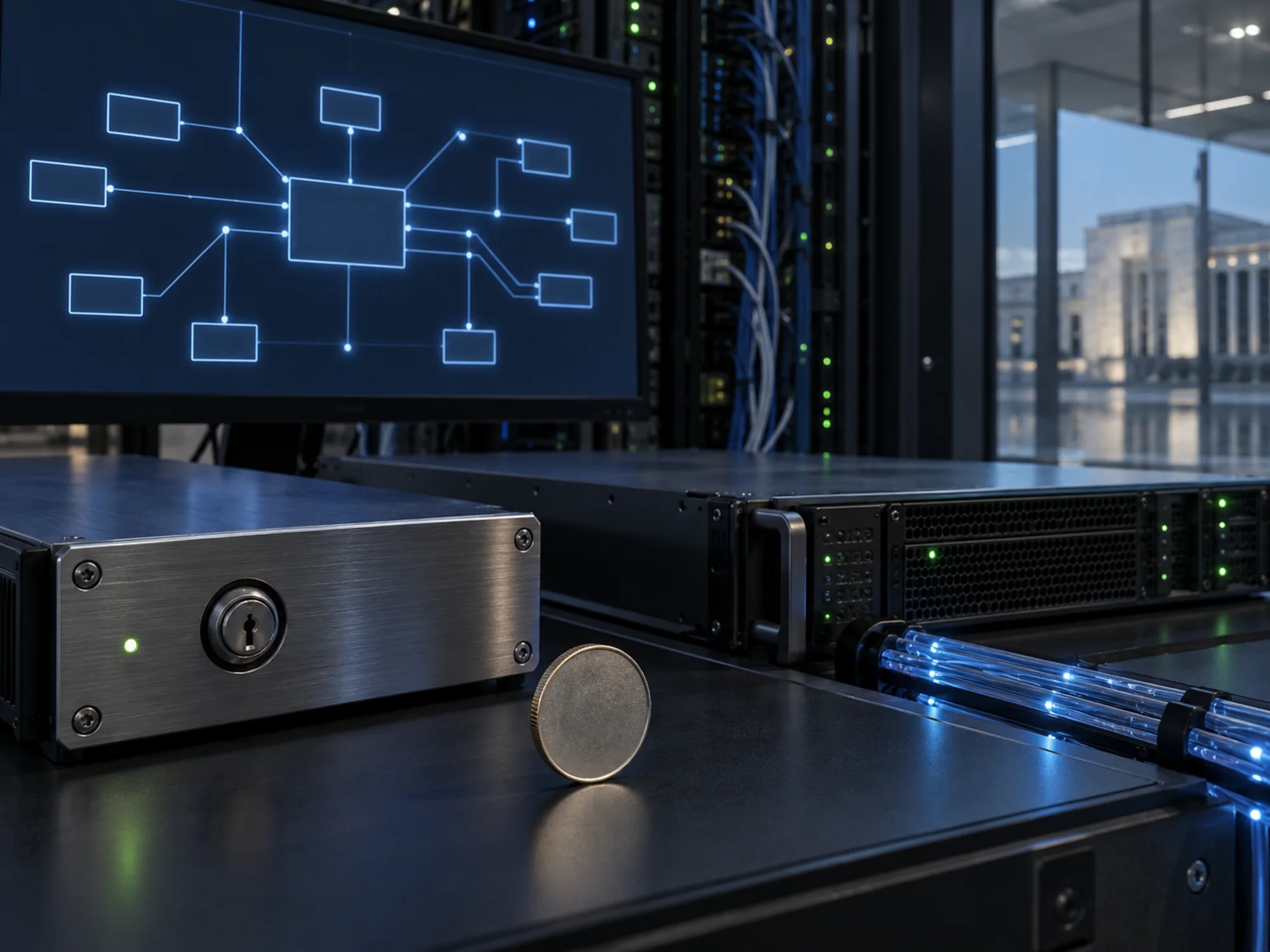
What T2, TIPS and T2S each settle
T2 is the real-time gross settlement system for the euro. Each payment settles on its own, immediately and with finality, with no netting against other payments. Monetary policy operations of the Eurosystem settle here, together with interbank payments and the cash leg of commercial transactions. The volumes are large: the system moves close to the euro area's annual GDP every few days, and more than 1,700 banks send payments into it.
TIPS settles instant retail transfers around the clock, including weekends and holidays, in central bank money. T2S settles securities transactions, with the cash and the securities leg in one place. The three share a single access point and a single liquidity view since the consolidation.
ECMS, Pontes and the services beyond payments
Two more services belong to the same family, and a payments team meets both. The Eurosystem Collateral Management System is the single platform for the assets a bank pledges for central bank credit. Before it, each national central bank ran its own collateral procedures, and a bank active in several countries kept several processes. Intraday credit and auto-collateralization in T2 draw on what ECMS manages, which is why a liquidity plan now runs through it.
Pontes is the newest member: a distributed ledger solution that links market DLT platforms to the TARGET Services so transactions on those platforms settle in central bank money. Finance Loop covers that work in wholesale CBDC. All of it sits under the Market Infrastructure Board, follows the single TARGET operating schedule, and speaks ISO 20022.
The consolidation and central liquidity management
Before the consolidation a bank held separate liquidity for payments and for securities settlement, and moved money between the two by hand. The consolidation of T2 and T2S replaced that with one central liquidity management module. A bank now holds a main cash account and dedicated cash accounts for the individual services, and the module moves liquidity between them during the day.
For a payments team the practical change is the ordering of payments. Priorities, reservations and limits decide which payment settles first when liquidity is tight, and those settings sit in the central module instead of in two places.
Who can hold a TARGET account
Credit institutions established in the European Economic Area get direct access through their national central bank. The Bundesbank is the point of contact for German participants. Investment firms, clearing houses and other financial institutions can be admitted under the conditions in the TARGET guideline.
A payment institution or e-money institution has a harder route. It is not a credit institution, so in most cases it reaches settlement indirectly, through a sponsoring bank that holds the account, or through a scheme participant for instant payments. That dependency is a strategic question for a licensed payment firm, and Finance Loop covers the license side in payments regulation in Germany.
How a ten-second instant transfer settles through TIPS
The payer's bank sends the credit transfer message, the payee's bank checks it and answers, and TIPS debits one dedicated cash account and credits the other. The money is central bank money at that moment, so the payee's bank takes no credit risk on the payer's bank and can release the funds immediately.
The scheme sets a ten-second window for the whole exchange, which is why the account service on both sides has to be available continuously. Finance Loop covers the scheme rules and the regulation in instant payments in Europe, and the name check that now runs before the transfer in verification of payee.
Operating days, cut-offs and what an outage means
T2 runs on TARGET business days, which exclude weekends and six common holidays, and its day has fixed cut-offs: one for customer payments, a later one for interbank payments, and an end-of-day procedure. A payment submitted after its cut-off settles the next business day, which is where an unexpected value date usually comes from. TIPS has no such calendar and settles every day of the year.
An outage in T2 stops large-value settlement for the euro area, and it has happened. The system has contingency procedures for very critical payments, and a participant has to have tested its own fallback: who decides a payment is critical, who sends it, and how the treasury desk learns that its funding leg did not settle.
Why this runs in Frankfurt
The ECB sits in Frankfurt and holds the legal responsibility for the TARGET Services, while the technical platforms are provided by the Bundesbank, the Banca d'Italia, the Banque de France and the Banco de España. That puts the governance of the euro's settlement layer in the same city as the ECB, the Bundesbank and the European anti-money laundering authority. Finance Loop covers the city in payments in Frankfurt.
What is the difference between TARGET2 and SEPA?
They work at different layers. SEPA is the set of scheme rules that says what a euro credit transfer or direct debit looks like and what each bank owes the other. T2 and TIPS are settlement systems where the money actually moves between banks in central bank money. A SEPA transfer is settled either in TIPS, in a clearing mechanism that settles its net positions in T2, or inside one bank.
Is TARGET2 still in operation?
The name is retired. T2 replaced TARGET2 as the Eurosystem's real-time gross settlement service at the consolidation, combining the payment function with central liquidity management. People in the market still say TARGET2 for the system, and messages and documentation now use T2.
TARGET2, TIPS and Finance Loop
Finance Loop is the meeting place for payments in Frankfurt, the city where the euro's settlement layer is governed. Finance Loop brings together the people who hold TARGET accounts, the payment firms that reach them through a sponsor, and the teams building the instant and tokenized rails that settle there.
Finance Loop is a professional network and has the goal of driving the adoption of emerging technologies in finance, such as AI, tokenization, stablecoins, and DeFi. Finance Loop helps its members build skills and personal networks in these fields: Investment & Digital Assets, Payments & Digital Money, Digital Infrastructure & Sovereignty, and Risk & Compliance.