
European Business Wallet (EBW)
The European Business Wallet is a proposed digital identity framework for companies and other economic operators interacting across Europe. It would let an organization identify itself, exchange verified information and demonstrate who can act on its behalf when dealing with public authorities and other businesses.
For financial institutions and business customers, its relevance lies in company onboarding, representation and the reuse of trusted business information. The proposal remains under negotiation, so companies should distinguish intended capabilities from binding requirements while preparing decisions about evidence, authority and operational ownership.
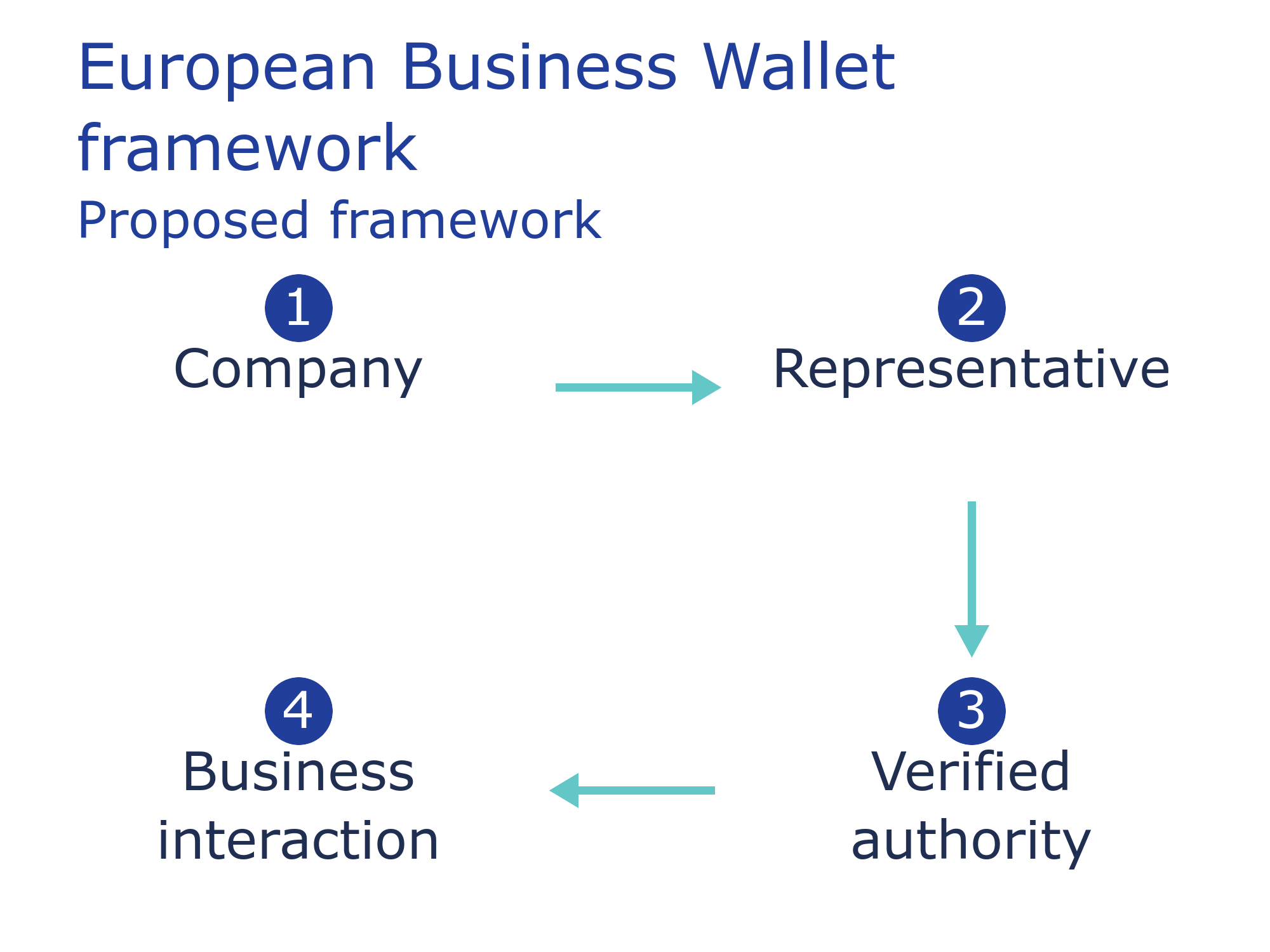
The proposal and its legislative status
The European Commission proposal was published on November 19, 2025, and would establish a separate regulatory framework for business wallets. The Council of the European Union adopted its negotiating position on June 9, 2026. These steps concern a proposed regulation whose final requirements can still change.
The European Parliament procedure file records confirmation of the negotiating mandate on October 7, 2026, while awaiting the Parliament position at first reading. As of October 26, 2026, the business wallet framework remains a legislative proposal awaiting adoption.
Business identity and personal identity
The proposed business wallet framework builds on the European Digital Identity Wallet architecture for identification, verified information and trusted digital actions. Its organizational scope addresses how an economic operator represents itself and communicates with counterparties. A person confirming an action and the company legally undertaking it remain distinct participants.
The EUDI Wallet provides the related framework for personal digital identity. In a business process, the receiving institution should establish both the individual identity and the authority connecting that person to the organization. Neither a familiar name nor a successful personal login proves corporate authority.
Representatives, mandates and revocation
The Council negotiating position includes delegating authority to representatives while preserving powers of attorney and legal mandates under national or Union law. A digital authorization mechanism therefore needs a clear relationship with the underlying legal authority. That relationship matters when transactions cross jurisdictions with different representation rules.
A finance team should define which employee can open an account, submit company information, sign a contract or approve a payment. Model the scope, duration and withdrawal of each authorization separately. When an employee leaves or a mandate changes, the institution needs a reliable way to reassess subsequent actions.
Company onboarding and the remaining KYB checks
A business wallet could supply verified company data and evidence of representation within a corporate onboarding journey. The receiving institution still needs to decide which issuer it accepts, whether information remains current and which controls apply to that relationship. Wallet presentation should inform a documented verification decision, with customer approval subject to that assessment.
Know your business verification also examines ownership, control and the people behind the company. The Stripe Connect verification documentation illustrates separate checks for businesses, representatives and beneficial owners, while retaining independent legal responsibilities. Corporate risk assessment, sanctions checks and ongoing monitoring therefore need their own process owners.
Signing, sealing and exchanging business information
The Commission proposes business wallet functions for identifying counterparties, exchanging credentials, signing, timestamping and sealing documents, alongside secure business communications. Those functions address different evidence needs within a commercial relationship. A signature by a representative and a seal associated with an organization should have distinct acceptance criteria in procurement and operations.
Start with one company workflow, such as submitting verified registration information during cross-border account opening. Record the required attributes, the recipient and the result the institution must retain. The qualified electronic signature remains a separate trust-service topic when a particular signing requirement applies.
Acceptance obligations remain part of the proposal
The Commission explanation of business wallets proposes acceptance by public administrations within two years after adoption, while leaving business uptake voluntary. These are proposed arrangements tied to a future adopted text. They do not establish a current obligation for every company to acquire or accept a business wallet.
The Council also proposes compatibility with existing national business and administrative systems, with national procedural requirements continuing to apply. Companies comparing providers should distinguish proposed legal duties, available pilot capabilities and contractual product promises. A roadmap should identify which dependencies require final legislation or further technical specifications before production commitments.
Preparing a financial use case
The WE BUILD consortium tests wallet use cases including business due diligence, company representatives, corporate banking and corporate payments. Pilot participation demonstrates work on practical applications, while individual production availability needs separate verification. Financial buyers should ask which credentials, countries and counterparties a proposed integration actually supports.
Choose one accountable business owner and agree success measures before connecting providers. Useful measures include repeated data requests, unresolved authority checks and time spent obtaining updated company evidence. Identity orchestration in finance provides the wider process context when several verification and approval systems participate.
Questions about the European Business Wallet
Must companies already use a European Business Wallet?
The framework remains a legislative proposal, and the Commission proposes voluntary uptake by businesses without a general purchase obligation.
Does a business wallet replace beneficial ownership checks?
Verified company identity and representative authority do not establish the complete ownership structure or satisfy every customer due diligence requirement.
Payments events across Europe
The calendar needs JavaScript to display upcoming events on this page.
Business identity and Finance Loop
Finance Loop connects professionals across Europe working on emerging technologies in finance, including corporate identity and digital trust. Finance Loop supports exchange between companies assessing financial onboarding, representation and cross-border business processes as the proposed wallet framework develops.
Discuss your business identity priorities
Contact Finance Loop to discuss your corporate identity priorities and connect with relevant professionals across the European financial industry.