
Frankfurt financial center history
Frankfurt financial center history is the history of how a trading city became a location for banks and international capital markets. Merchants needed to exchange money and finance their trade. Those activities gradually developed into banking and securities markets.
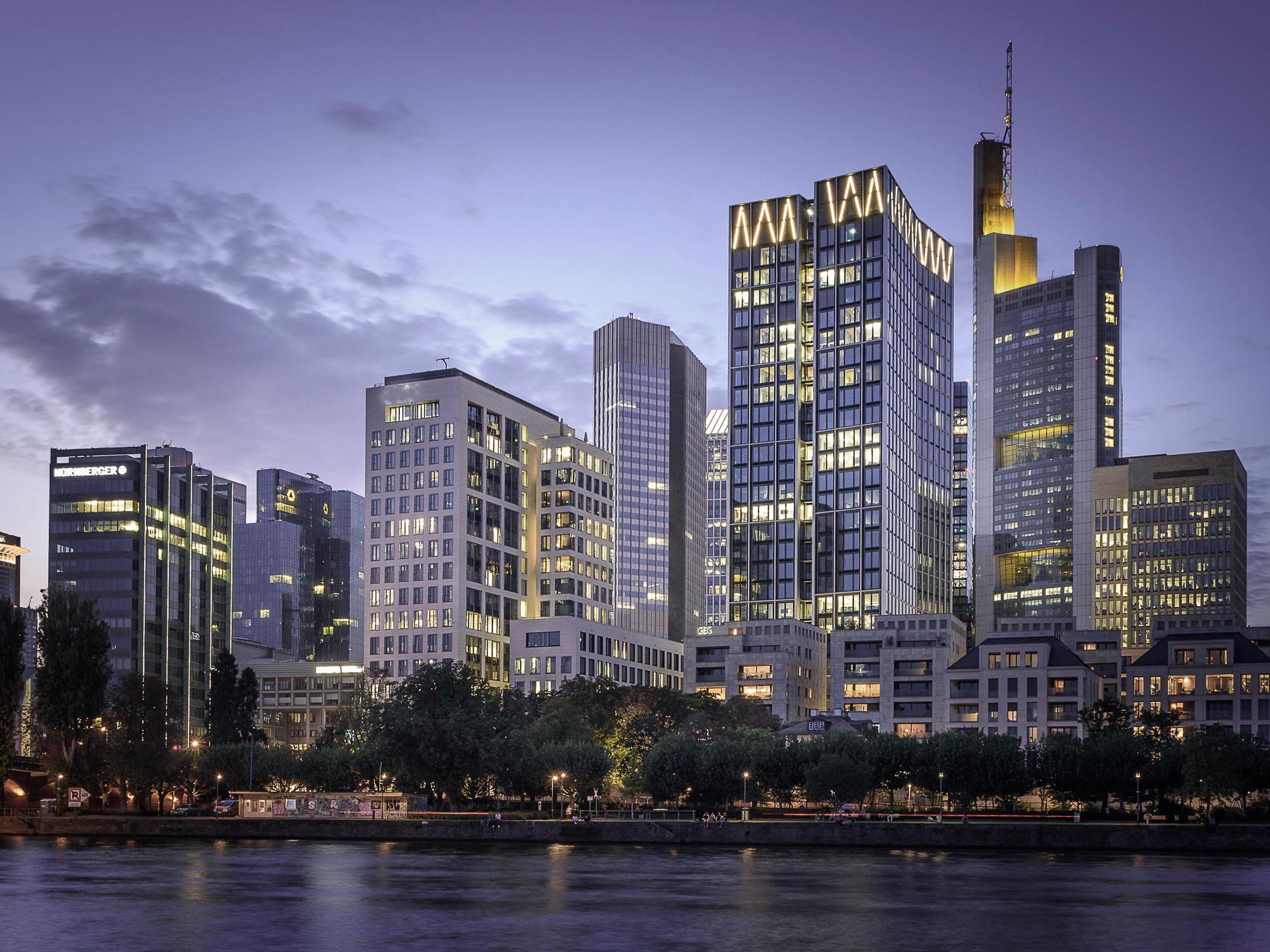
The financial center in Frankfurt has several distinct parts. Commercial banks serve businesses and investors, exchanges organize trading, and central banks carry out monetary responsibilities. The banking district and skyline make finance visible, but the financial center began centuries before the construction of its high-rise buildings.
Trade, institutions and the city
Frankfurt's role expanded through political decisions, changes in monetary systems and the rebuilding of institutions after war. The city grew around these activities.
Frankfurt's development includes periods of growth and severe disruption. Medieval fairs, private bankers and postwar central banking belong to different chapters. The establishment of European institutions later gave the city responsibilities reaching beyond Germany.
Medieval fairs and international trade
Frankfurt's fairs brought merchants together to sell goods and settle accounts across borders. The first written reference dates to 1150; Emperor Frederick II granted protection to autumn fair visitors on 11 July 1240. Safe journeys and regular markets helped merchants return. Payments were complicated by the different coins carried into the city, each with its own value. Money changing became part of the work surrounding the sale of cloth and other merchandise.
The foundation of the Frankfurt Stock Exchange
The Frankfurt Stock Exchange began with a practical response to those payments. On 9 September 1585, merchants agreed on common exchange rates. The agreement made transactions easier to calculate in a market with many currencies. Currency trading preceded the familiar stock market: the exchange's origins were in commerce and settlement, long before electronic order books. Frankfurt's experience with cross-border payments therefore reaches back well beyond the banks and towers visible today.
Private bankers and the financing of states
Frankfurt's private banking houses grew from merchant businesses. Metzler started as a cloth trading company in 1674 (in German). Credit and bills of exchange gradually became banking business. Bethmann and Rothschild later arranged financing for European rulers. Bethmann's government loan of 1779 was divided into securities that individual investors could buy. That structure pooled capital from several investors. During industrialization, infrastructure financing expanded the demands placed on banks; Bethmann and Rothschild participated in financing the Taunus Railway through a share issue in 1837.
Berlin, persecution and the Second World War
Frankfurt's standing changed as Berlin became the capital of the German Empire and a larger securities market. Frankfurt retained international trading relationships, but Nazi rule restricted securities trading from 1933. Jewish families faced persecution and dispossession, including the Goldschmidt-Rothschild family (in German). These crimes belong to the financial center's history alongside its commercial achievements. War then damaged the city's buildings and exchange. The reopened exchange began trading again in September 1945, under very different political and economic conditions.
The Bank deutscher Länder and the Bundesbank
Postwar reconstruction gave Frankfurt a new institutional role. The Bank deutscher Länder was founded in 1948 and coordinated the new monetary system. The Bundesbank Act of 26 July 1957 took effect on 1 August 1957, replacing the earlier central banking structure with the Deutsche Bundesbank. Monetary policy and banking business became concentrated in the same city. The expansion of domestic and foreign banking operations after the war helped establish the modern financial center. Central banking remained a different responsibility from lending and securities trading.
The banking district and the high-rise skyline
Frankfurt's banking district developed alongside the postwar financial center. The towers were built within a city that also needed housing, transport and public space. Postwar high-rise planning progressed from individual towers and axes toward clusters (in German). The study produced in 1998 was adopted as a development plan in 2000. The skyline is therefore a product of planning decisions as well as demand for offices. Frankfurt's 2024 high-rise development plan (in German) addresses mixed uses, public spaces and the relationship between towers and surrounding neighborhoods.
The ECB and the introduction of the euro
The European Central Bank added a European monetary institution to Frankfurt's national central bank. The ECB was established on 1 June 1998, replacing the European Monetary Institute. The euro followed as a currency for accounts and electronic payments on 1 January 1999; notes and coins entered circulation on 1 January 2002. Frankfurt became the place where euro-area monetary decisions are made. The Bundesbank continued as a national central bank within the Eurosystem, with responsibilities distinct from those of commercial banks.
From the trading floor to electronic markets
The financial center changed technologically as well as institutionally. Computer-supported exchange processing started in 1969, and Xetra launched on 28 November 1997. Electronic trading connected participants without requiring them to stand together on a trading floor. Reliable systems and rules for order execution became part of the market's daily operation. Trading also depends on the transfer of money and securities after a transaction. The activities of Deutsche Börse Group connect this capital-market history with the financial infrastructure used by institutions today.
Brexit and European banking operations
Brexit changed how banks based in the United Kingdom could serve customers in the European Union. From 1 January 2021, UK-based banks could no longer use EU passporting rights. International groups moved business to euro-area subsidiaries. The requirements concerned local risk management and control over the transactions booked by those entities. Frankfurt's financial center participates in this European banking system, alongside other cities. Brexit added a regulatory reason to maintain EU operations; the resulting changes cannot be measured simply by counting offices or comparing skylines.
Institutions and financial-center policy today
Frankfurt's history continues through the institutions established in the city and the policies governing finance. On 22 February 2024, the European Parliament and Council agreed that Frankfurt would host AMLA, the EU anti-money laundering authority. AMLA in Frankfurt adds a European supervisory function. The Hessen financial center cabinet and the Frankfurt financial center strategy address the location's further development. Their work concerns the present institutional setting, while the city's commercial history explains how that setting came about.
Frankfurt's financial center and Finance Loop
Finance Loop connects professionals working in finance and emerging technologies. Finance Loop's strategic partners are Frankfurt Main Finance and TechQuartier. Discussions at meetups address the financial center's current technology and market questions.
Finance Loop is a professional network and has the goal of driving the adoption of emerging technologies in finance.