
HSM for crypto
A hardware security module, or HSM, is a device that protects cryptographic keys and performs operations using them inside protected hardware. Banks use HSMs for tasks such as checking card PINs and managing payment keys. In crypto custody, an HSM can hold a private key and create the signature needed to authorize a blockchain transaction.
Protecting a private key matters because access to it can allow someone to authorize transfers of crypto-assets. An HSM separates cryptographic operations from the general-purpose software that requests them, limiting direct access to the key. Custodians still need authorization rules and operational controls around crypto custody to decide which transaction requests the device may sign.
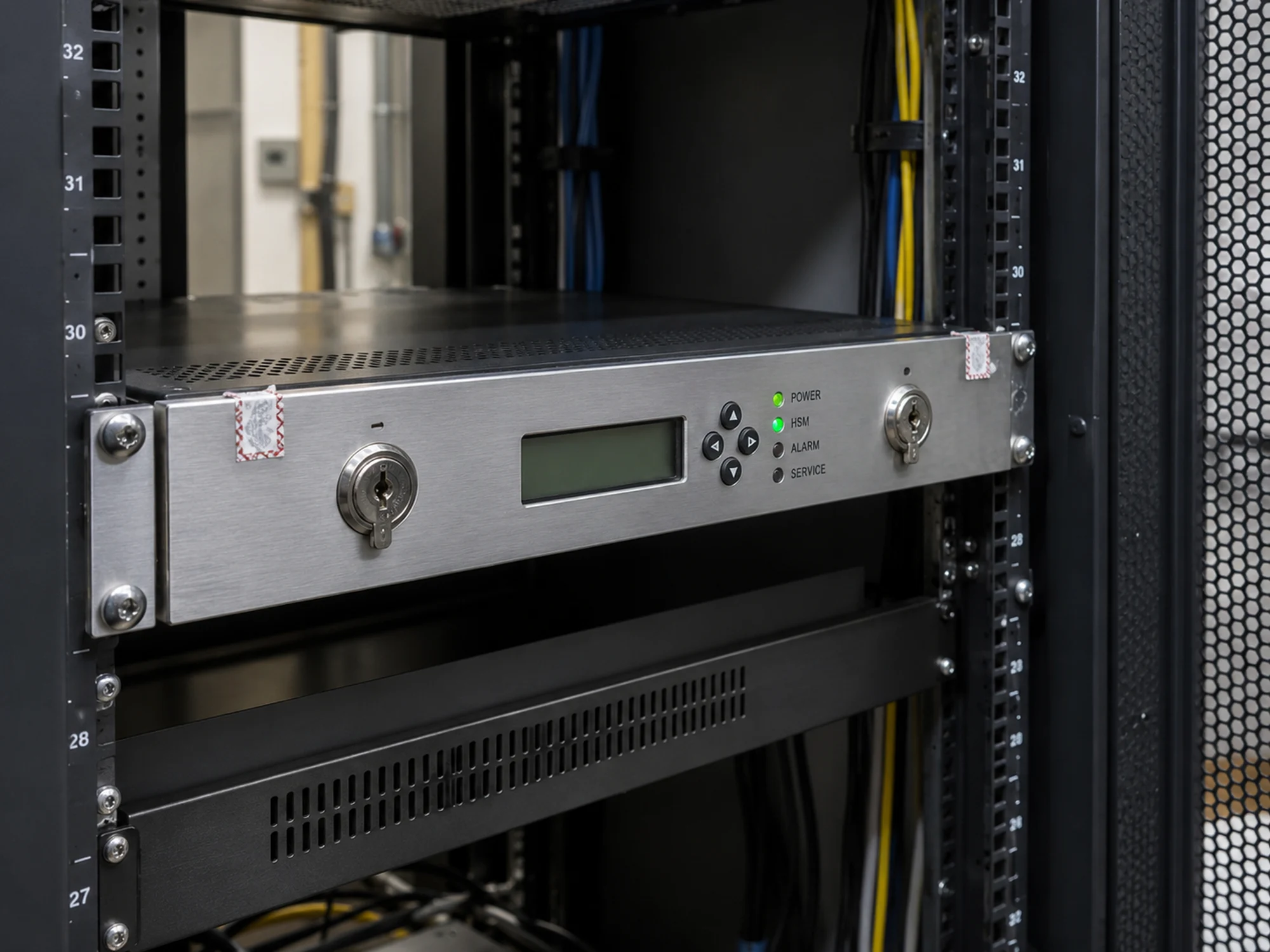
The HSM behind a card payment
PIN checks and chip card transactions run on keys held in HSMs at card issuers and payment processors. The PCI Security Standards Council sets the rules in its PTS HSM standard, which covers the whole life of the device. PCI-recognized laboratories test each device, and the council publishes a list of the approved ones. Version 4.0 covers card verification, PIN processing, chip transaction processing, card personalization and key loading, and added an approval class for cloud HSMs sold as a service, as Help Net Security reported.
The page on PCI DSS 4.0 covers the data security rules that apply around these devices.
How an HSM protects a crypto key
In crypto custody the HSM keeps private keys non-exportable and signs inside the device. Only the signature leaves it, so an attacker on the server cannot copy a key file. Staff can only request signatures, and the custodian logs and rate-limits those requests, as the BIT knowledge hub on HSMs describes. The same source explains the NIST standard FIPS 140, which grades devices from Level 1 to Level 4, and names Level 3 or 4 as the usual choice of institutional custodians.
The key management guide of Ripple Custody states that every HSM it supports meets at least FIPS 140-2 Level 3. The Ripple Custody key management guide names the Swiss vendor Securosys as available case by case and lists rented cloud instances such as AWS CloudHSM as an option. The page on crypto custody in Germany covers the license a custodian needs.
MPC vs HSM: the choice per vault
An HSM keeps one key in one hardened device, while multi-party computation offers an alternative. An MPC wallet splits the key into shares held in several places, so no single device or person has all of it. Ripple Custody lets the client choose HSM or MPC per vault. The two differ in recovery: HSM backups are physical, for example smart cards, and need a secure offline procedure, while MPC shares can be reshared online.
A move to post-quantum cryptography also runs through the HSM, since the device has to support a new algorithm before a bank can sign with it. The page on cryptographic agility covers that migration.
Upcoming events on digital assets and security in Germany
Finance Loop and key security
Finance Loop covers the key layer of digital assets on its pages on crypto custody, MPC wallets, account abstraction and post-quantum cryptography in finance. Finance Loop events in Frankfurt bring together people from banks and custodians who work on tokenized money and securities.
Digital Infrastructure & Sovereignty
Payments & Digital Money
What is an HSM in crypto?
An HSM is a certified hardware device that generates and stores the private keys of a crypto custodian or exchange and signs transactions inside the device, so the keys never exist in plain form outside it.
What is the difference between an HSM and a hardware wallet?
A hardware wallet is built for one person who holds the device and the seed phrase. An HSM is built for an institution: it is certified under FIPS 140 or PCI PTS and can require several people to approve a signature.
What is a payment HSM?
A payment HSM is an HSM approved under the PCI PTS HSM standard for card and PIN processing, such as PIN checks, card verification values and the personalization of new cards.
Is MPC safer than an HSM?
Neither is safer in general: an HSM protects one key in certified hardware, and MPC removes the single place where the key exists. The choice depends mostly on how keys are recovered and what the supervisor requires. Ripple Custody offers both.
HSM crypto and Finance Loop
Finance Loop covers hardware security modules in its Digital Infrastructure & Sovereignty track, starting with the payment HSMs banks run for cards and including the signing hardware of crypto custodians. Finance Loop brings people from banks, custodians, payment processors and security teams together at events in Frankfurt, Munich, Berlin and Hamburg.
Finance Loop is a professional network supporting the institutional use of emerging technologies in finance, such as AI, digital payments, cloud and blockchain solutions. Finance Loop helps its members build skills and personal networks in these fields: Investment & Digital Assets, Payments & Digital Money, Digital Infrastructure & Sovereignty, and Risk & Compliance.