
Market data feeds
A market data feed is a continuous stream of prices, trades, quotes and order book changes that a trading venue or a data vendor sends to the systems of its subscribers. Each message carries an instrument identifier, a price, a size and a timestamp, so a trading engine or a risk system can follow the market without anyone reading a screen.
Banks, asset managers, brokers and market makers connect these feeds to order routing, valuation, risk limits and client apps, and the feed decides how fast and how completely each of those systems sees the market. Exchanges sell direct feeds of their own order books, vendors merge hundreds of venues into one consolidated feed, and onchain feeds now turn trades on blockchains into the same kind of stream.
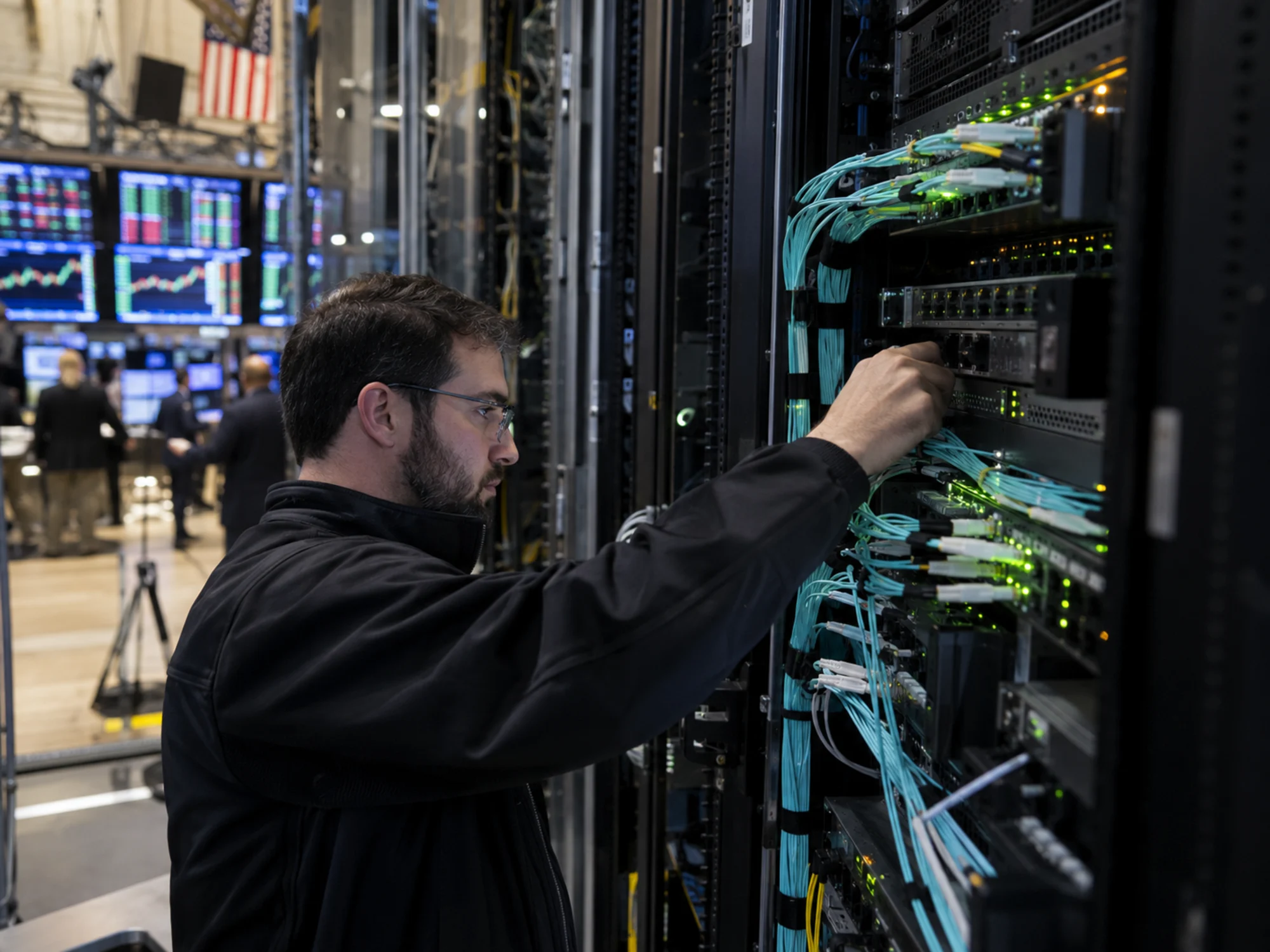
What a market data feed carries
A market data feed carries trade reports, quotes with the changes of the order book and reference data on the instruments that trade. Trade reports state what was executed at which price and size. Quotes show what buyers and sellers offer before a trade happens, and reference data describes the instrument itself, with identifiers such as the ISIN, trading hours, tick sizes and the current trading status.
Level 1 data is the best bid, the best offer and the last trade of an instrument. Level 2 data adds the price levels below the best bid and above the best offer, and order-by-order data shows every visible order on its own. Deutsche Börse sells all three for Xetra and Eurex, starting with CEF Core for level 1 and level 2 information, CEF Ultra+ with un-netted data up to 10 price levels for Xetra and 15 for Eurex, and CEF Ultra+ Order by Order with every visible order at unlimited depth.
Real-time, delayed and historical market data
A real-time feed sends each update the moment it happens, while a conflated feed sends the latest state at fixed intervals and saves bandwidth for screens that people read. Delayed data costs less and suits websites and apps for private investors. Under Article 13 of MiFIR, trading venues in the EU offer their pre-trade and post-trade data on a reasonable commercial basis and must make it available free of charge 15 minutes after publication.
Historical tick data is the same stream stored for later use, and quant teams replay it to test a trading strategy against past market conditions. Which of these uses a subscriber may run is a matter of contract, and market data licensing separates display use, non-display use and derived data, each with its own fee.
Delivery: multicast, FIX, WebSocket and APIs
Exchanges deliver their fastest feeds by UDP multicast inside the data center, where trading firms rent space next to the matching engine for low-latency trading. The T7 platform of Xetra and Eurex sends its market data interfaces over multicast with FIX 5.0 SP2 semantics and FAST encoding, and every channel goes out twice on two addresses, an A and a B service, so a packet lost on one line can be taken from the other.
Vendors and cloud services deliver over WebSocket and REST APIs instead. LSEG Real-Time Optimized runs in public cloud regions and offers access through WebSocket, C++, Java and Python, and Deutsche Börse sends its Cloud Stream through a WebSocket endpoint without a physical line. A REST API suits snapshots and history, while a streaming connection suits a system that has to react to every change of a price.
Feed handlers and normalization
A feed handler is the software that reads the raw messages of a venue, puts them back in sequence, rebuilds the order book and hands the result to the systems of a firm in one internal format. Every exchange has its own message layout, sequence numbers and recovery process, so a bank connected to twenty venues runs twenty handlers or buys a normalized feed from a vendor.
Normalization maps symbols, prices and trading states of all venues to one data model, and next to coverage it is the main thing a consolidated feed sells. Some trading firms decode messages on FPGA cards in hardware, because every microsecond spent on decoding delays the reaction of an algorithm to a new price.
Exchange feeds and data vendors
Market data feed providers fall into two groups: the trading venues that produce the data and the vendors that collect it from many venues. A direct feed from the venue gives the fastest and most complete view of that one market, and a consolidated feed gives up some speed in exchange for one format across many markets.
LSEG states access to 90 million instruments across 550 venues for its cloud service Real-Time Optimized. Bloomberg describes its enterprise feed B-PIPE with 35 million instruments from more than 330 exchanges and 80 billion ticks a day. The ICE Consolidated Feed of Intercontinental Exchange combines more than 600 sources and over 300 trading venues and offers full tick, conflated and delayed services.
In the EU a consolidated tape will gather the trades of all venues in one stream. ESMA has selected the consolidated tape providers: Ediphy with fairCT for bonds, EuroCTP for shares and ETFs, and Etrading Software for OTC derivatives. Trading venues must send their data to these providers once the tapes start operating.
Onchain market data feeds
Onchain market data feeds turn trades on decentralized exchanges into the same stream of prices and sizes that a trading desk receives from a stock exchange. Every swap settles in a block, so the raw data is public, but it arrives as contract events in a different format for each protocol and blockchain and needs decoding before a trading system can use it.
Dune Market Data Feeds is a product of this kind for institutional trading systems. Dune, the onchain data platform, launched the feeds with spot trades from more than 200 onchain venues on 12 networks, among them Ethereum, Solana and Base, and with perpetual futures trades on Hyperliquid and Lighter. Spot updates arrive about one second after the block that contains the trade, and each record names the instrument, the venue, the side, the price and the value in US dollars.
Dune adds reference data on which instrument trades on which venue, and historical trade data for backtesting is sold separately. The feeds see a trade only after it settles onchain, so private requests for quotes and some activity routed through aggregators and solvers stay outside them. Dune ties the launch to tokenized stocks, because OKXICE, the joint venture of OKX and Intercontinental Exchange, filed to list 63 tokenized US shares on the X Layer network, according to Dune.
Crypto data vendors and price feed providers
Crypto data vendors combine the order books of centralized exchanges with onchain sources and deliver them as one feed to institutional clients. Kaiko sells market data feeds and calculates benchmarks as an administrator under the EU Benchmarks Regulation. Amberdata adds derivatives and blockchain data and has belonged to Kaiko since June 2026.
CoinDesk Data sells trade, order book and onchain data from more than 300 centralized and decentralized exchanges to banks, exchanges and index providers. A fund that values crypto holdings needs a reference rate with a published methodology more than raw speed, which is the service of crypto price feed providers with registered benchmarks.
Oracle networks: price feeds for smart contracts
An oracle network carries market data into a blockchain, where lending protocols and other smart contracts read prices to value collateral and settle positions. Chainlink runs Data Streams, which send low-latency market data offchain first and verify it onchain, so an application pays only for the prices it uses. Pyth Network collects prices that trading firms sign from their own order books and combines several submissions into one price with a confidence interval.
The rules for sourcing and updating a price differ between oracle networks, and they decide how far a contract can trust a price when the market moves fast.
Market data at Finance Loop events
Finance Loop supported the AI & Market Data meetup in Paris, hosted at FactSet, where practitioners from financial institutions, data providers and fintechs discussed AI on financial market data. In Frankfurt, Finance Loop held a MarketVector Indexes panel on crypto indices at TechQuartier. A Chainlink panel at TechQuartier, a pre-event of the Crypto Assets Conference, opened with the oracle networks of Chainlink for smart contracts.
Upcoming Finance Loop events
Market data feeds and Finance Loop
Finance Loop covers market data feeds in its Digital Infrastructure & Sovereignty track, where data centers, cloud delivery and feeds meet, and covers trading and onchain data in the Investment & Digital Assets track. Finance Loop brings market data managers from banks and asset managers together with exchanges and data vendors at its events in Frankfurt.
Finance Loop is a professional network and has the goal of driving the institutional use of emerging technologies in finance, such as AI, tokenization, stablecoins, and DeFi. Finance Loop helps its members build skills and personal networks in these fields: Investment & Digital Assets, Payments & Digital Money, Digital Infrastructure & Sovereignty, and Risk & Compliance.