
FX settlement risk
FX settlement risk is the risk that one party delivers the currency it owes in a foreign exchange trade and does not receive the other currency in return. The two payments may be processed by different systems at different times, creating exposure between them. The potential loss is the full amount delivered, which makes this a principal risk.
The term Herstatt risk refers to the failure of the Cologne bank Herstatt in 1974, when counterparties had paid Deutsche Mark but did not receive the corresponding US dollars. Banks manage this exposure when arranging currency trades and choosing settlement methods. Payment-versus-payment arrangements link the two final currency transfers so that one occurs only if the other also takes place.
The Herstatt case
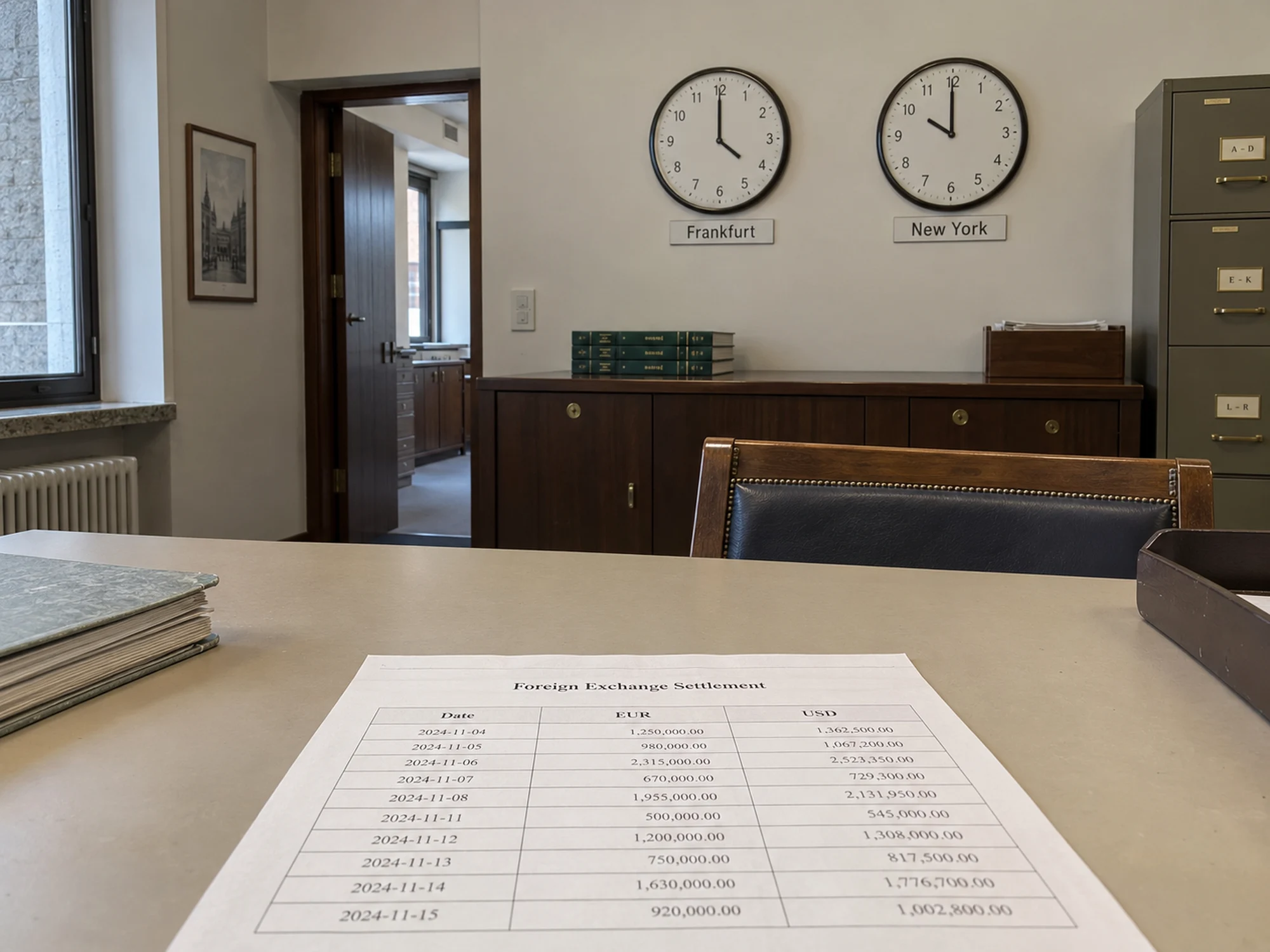
On 26 June 1974 the German supervisor withdrew the license of Bankhaus Herstatt, then the 35th largest bank in the country. The German supervisor acted after the close of business in Germany, while the US business day was still running, as the Bank Underground blog of the Bank of England recounts from its archives. Counterparties had already paid Deutsche Mark to Herstatt and were waiting for the dollar leg in New York, which never came. Banks in other countries then held back their own payments, and the New York Clearing House introduced a recall procedure on 1 July 1974.
How CLS and payment versus payment remove it
Payment versus payment (PvP) settles both legs at once, or neither. CLS is the main PvP service for currency trades: CLS Bank began operating on 9 September 2002, settles 18 currencies, and is overseen by the Federal Reserve. Members pay in their net amounts during a five-hour window when the payment systems of all CLS currencies are open, and CLS pays out only when both legs are there. Netting reduces the cash members have to fund by about 96 percent.
Other PvP arrangements exist for currencies outside CLS. SIX, for example, describes FXS, a PvP system authorized by the Banco de España for euro area banks.
How much is still at risk
The BIS measured settlement for the first time in its 2025 Triennial Survey. The BIS analysis in the June 2026 Quarterly Review counts more than 14 trillion dollars of FX obligations settled on an average day in April 2025. About 36 percent settled PvP and 54 percent through methods that reduce the risk without removing it, such as netting and settlement within a banking group. About 10 percent, more than 1.4 trillion dollars a day, settled gross and bilaterally with the full principal at risk. Around a quarter of that could have used PvP and did not; for most of the rest the counterparty had no PvP access or the currency pair was not eligible.
Settlement risk beyond the big banks
The remaining risk sits with smaller banks, non-bank financial firms and currencies outside CLS. The BIS authors point to wider PvP access for non-banks and more currencies as the next steps. Tokenized settlement promises the same atomic exchange on a shared ledger, an approach relevant to wholesale CBDC and settlement finality and the legal question of when a payment counts as final.
Upcoming finance events
What is Herstatt risk?
Herstatt risk is another name for FX settlement risk: the risk that a bank pays the currency it sold and does not receive the currency it bought, because the counterparty fails between the two payments. Herstatt risk is named after Bankhaus Herstatt in Cologne, closed on 26 June 1974.
How does CLS remove settlement risk?
CLS settles both legs of a currency trade at the same moment on its own books and pays out only when both sides have paid in. If one side does not pay, the other side gets its money back.
Why is not all FX settled payment versus payment?
According to the BIS, most trades settled with full risk involve a counterparty without PvP access or a currency or trade type that the PvP services do not cover. A quarter could have used PvP and were settled gross anyway.
FX settlement risk and Finance Loop
Finance Loop brings together treasury, risk and market infrastructure professionals in Frankfurt who deal with settlement every day. Finance Loop has partnered with the Crypto Assets Conference of Frankfurt School and Deutsche Börse Group, where market infrastructure and tokenized settlement are on the program.
Finance Loop is a professional network supporting the institutional use of emerging technologies in finance, such as AI, digital payments, cloud and blockchain solutions. Finance Loop helps its members build skills and personal networks in these fields: Investment & Digital Assets, Payments & Digital Money, Digital Infrastructure & Sovereignty, and Risk & Compliance.